
Setup an appointment
Treat hemorrhoids without surgery.
Hemorrhoid embolization — the Emborrhoid technique — is a minimally invasive, image-guided procedure that treats hemorrhoids by gently blocking the superior rectal arteries. No surgery, no scopes, no anorectal wounds, and continence is preserved. Performed as an outpatient by Dr. Atabak Allaei, a dual board-certified specialist in selective embolization.
Hemorrhoid embolization at a glance
Image-guided procedures by our physician
Hemorrhoid embolization (the Emborrhoid technique) is a minimally invasive, image-guided treatment for hemorrhoids. Through a tiny catheter placed in the wrist or groin, Dr. Allaei blocks the superior rectal arteries with tiny coils to reduce blood flow to the hemorrhoidal tissue — no surgery, no scopes, and no manipulation of the anorectal region. It has a 90–100% technical success rate, preserves continence, and most patients go home the same day.
Technical success
Key takeaways: hemorrhoid embolization
What to know
- Non-surgical and outpatient: the Emborrhoid technique treats hemorrhoids by blocking the superior rectal arteries through a catheter — no surgery, no scopes, and no manipulation of the anorectal region.
- Local and sometimes mild IV anesthesia: performed through a small artery in the wrist or groin using local anesthesia, with no general anesthesia required.
- 90–100% technical success rate, with clinical success ranging from 63–94% across published studies.
- ~75% patient satisfaction rate, reflecting the short procedure time, low complication rate, and quick recovery.
- 1-hour procedure with same-day discharge: most patients return home 1–2 hours after treatment and resume normal activity quickly.
- Preserves continence with no anorectal wounds: the procedure does not affect bowel control and creates no rectal wounds requiring local care.
Find out in under a minute – no phone call needed.
What are hemorrhoids?
Hemorrhoids are swollen veins in the anus and rectum — one of the most common anorectal problems, affecting nearly 340 million people worldwide.
Hemorrhoids are one of the most common problems of the anus/rectum (the anorectal region).1,2 They affect over 4.4% of the world population — which amounts to nearly 340 million people.3
What are the hemorrhoid types?
Based on location relative to the dentate line, hemorrhoids are either internal (above) or external (below) — which determines whether they cause painless bleeding or pain and itching.
Before we learn more about hemorrhoid types, it is important to understand what the dentate line is. This is a line located a third of the way up the anal canal, dividing it into two distinct areas.
Internal hemorrhoids
- Nerves only in deeper tissue layers (visceral innervation)
- Associated with painless bleeding during defecation
- Can prolapse (fall out of the anus)
- Graded I to IV by degree of prolapse
- The main target for embolization
External hemorrhoids
- Many nerves in skin and muscle tissue
- Tend to be more painful
- Present with itching and bleeding
- Easier to diagnose on visual inspection
- Thrombosed cases may need surgery
How are hemorrhoids diagnosed?
Hemorrhoids are diagnosed by visual and digital inspection — and, for internal hemorrhoids, sometimes anoscopy or proctosigmoidoscopy.
Hemorrhoids are commonly diagnosed using visual and/or digital (that is, using fingers) inspection by a doctor.5 External hemorrhoids are easier to diagnose, with a thorough visual inspection of the anal area.5 During this inspection, the doctor looks for signs of swelling, lumps, blood clots, leakage, skin irritation and anal fissures (tears).5
What are the hemorrhoid treatment options?
Treatment usually starts with fiber, fluids, and ointments, then rubber band ligation — with surgery or, more recently, embolization for cases that don't respond.
Hemorrhoid treatment typically begins with management strategies. These involve the use of stool softeners and an increase in the intake of dietary fiber and water.6 Other methods include the use of ointments, including those with nitroglycerine, to be applied at the site of the hemorrhoids.6 Infrared photocoagulation and bipolar diathermy are other frequently used treatment methods.2
In patients for whom these initial strategies do not work, the go-to treatment option, for internal hemorrhoids (grades I to III), is rubber band ligation.6 The last resort is surgical intervention, also known as excisional hemorrhoidectomy.6 Surgery is also used to treat external hemorrhoids that are filled with blood clots (called thrombosed hemorrhoids).6
However, surgical methods, necessary in around 10% of patients, are fairly painful and require a longer recovery time.1,6 Less invasive methods are, thus, more comfortable for the patient. One such method is hemorrhoidal artery ligation, which is commonly used to treat grade II and III internal hemorrhoids.2,6 Recently, another technique has come to the fore to treat hemorrhoids in a less invasive manner. This method, developed by an interventional radiologist at Aix-Marseille University (France), is called hemorrhoid embolization, or the ‘Emborrhoid Technique’.1,2,7
Hemorrhoid embolization vs. other treatments
Compared with rubber band ligation and surgical hemorrhoidectomy, embolization requires no anesthesia beyond local, creates no anorectal wounds, and carries no risk to continence.
| Factor | Hemorrhoid Embolization (HAE) | Rubber Band Ligation | Surgical Hemorrhoidectomy |
|---|---|---|---|
| Approach | Minimally invasive, catheter-based (wrist or groin artery) | In-office; band placed on hemorrhoid base | Surgical excision |
| Anesthesia | Local only | Usually none | General or spinal |
| Setting | Outpatient | Outpatient / office | Hospital or surgical center |
| Procedure time | 1–2 hours | Minutes | 45–90 minutes |
| Anorectal wounds / scars | None | None | Yes — surgical wounds |
| Pain level | Minimal | Mild | Significant; longer recovery |
| Recovery time | Same day; back to activity quickly | 1–2 days | Up to 2–4 weeks |
| Risk to continence | None | Low | Possible |
| Best suited for | Internal hemorrhoids that failed other treatments | Grade I–III internal hemorrhoids | Severe, thrombosed, or refractory cases |
| Technical success | 90–100% | Varies; recurrence common | High |
| Direct manipulation of anorectal region | No | Yes | Yes |
What is hemorrhoid artery embolization (HAE)?
HAE is an outpatient, non-surgical procedure in which Dr. Allaei blocks the abnormal superior rectal arteries through a tiny catheter — reducing the blood flow that feeds the hemorrhoids.
Hemorrhoid Artery Embolization (HAE) is an outpatient non-surgical procedure with minimal downtime. The procedure is done in an outpatient state-of-the-art center where Dr. Allaei performs the treatment through a tiny tube called a catheter. This procedure can be performed by either placing the catheter in an artery at the top of the leg (called a femoral approach) or by placing it into an artery in the lower arm (called a radial approach).
Embolization can be performed as an outpatient with only local anesthesia and does not involve any scopes or direct manipulation of the anorectal region.1,2 Embolization is the process of blocking a blood vessel to prevent blood flow to a part of the body. The reduced blood flow is what treats the hemorrhoids in this procedure.
The blood supply to internal hemorrhoids comes through the superior rectal arteries (SRAs), which branch from a larger blood vessel known as the inferior mesenteric artery.1 A tiny tube is inserted in this artery and a procedure called angiography is performed to visualize all the SRAs.1 Microcatheters (thin, micro-sized catheters) are then introduced in each SRA branch and the abnormal vessels are embolized (blocked) using tiny coils 2–3 mm in diameter.1 This entire process takes one to two hours and the medical term is rectal artery embolization.1
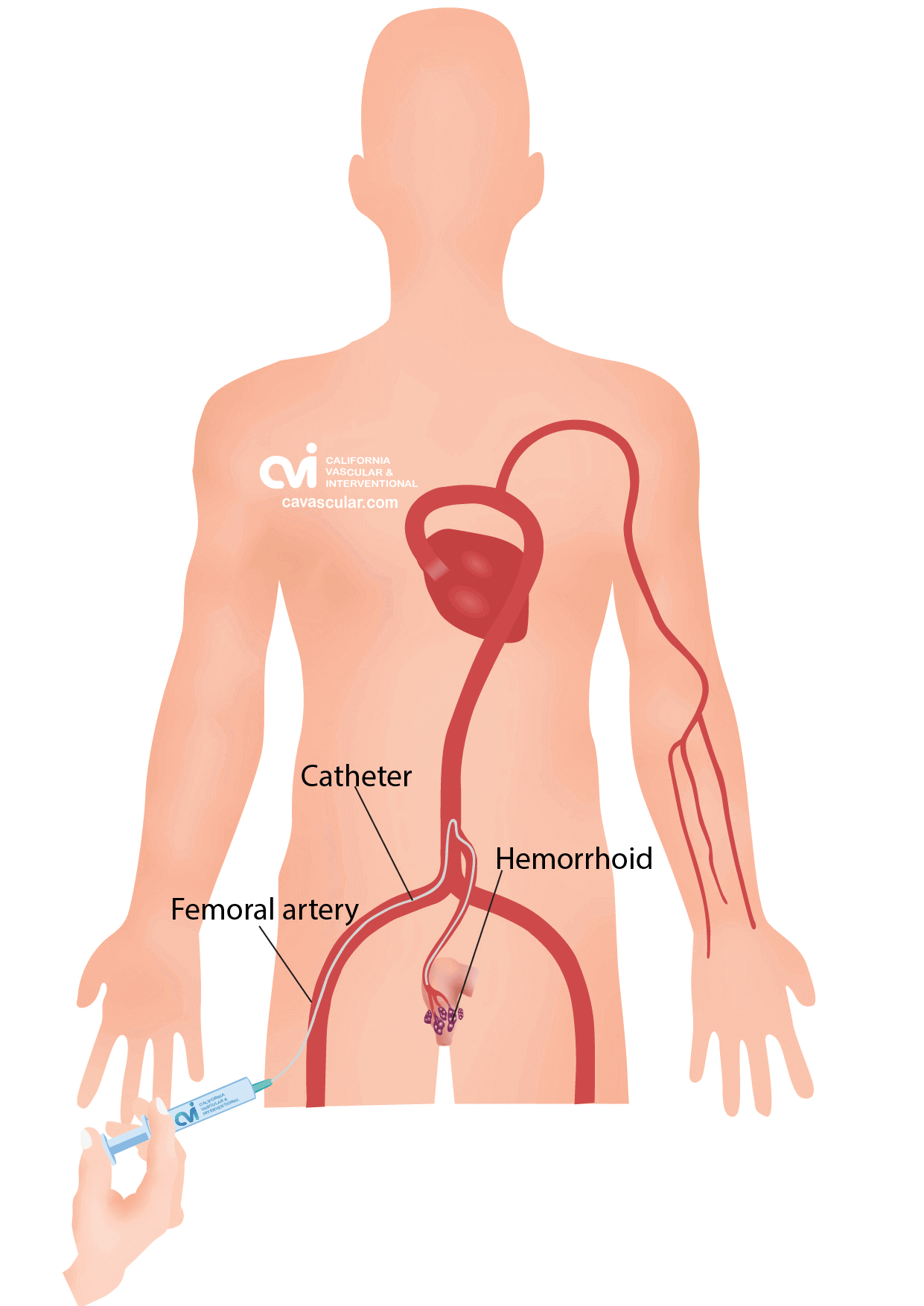
How is hemorrhoid embolization performed?
The procedure takes about one to two hours, under local anesthesia, with no scopes and no contact with the anorectal region.
Local anesthesia & access
Angiography
The catheter is guided to the superior rectal arteries and angiography maps all the SRA branches.
Microcatheter navigation
Thin microcatheters are advanced selectively into each SRA branch to reach the abnormal vessels — the most technically demanding step.
Embolize & go home
The abnormal vessels are blocked with tiny 2–3 mm coils (sometimes with microspheres). Most patients are discharged 1–2 hours later.
What are the HAE results?
HAE achieves a 90–100% technical success rate, with clinical success ranging from 63–94% across published studies.
Rectal artery embolization is technically successful if the doctor can block all the abnormal vessels.1 Notably, doctors are able to achieve a 90–100% technical success rate in the procedure.1,2 This is a good sign for the feasibility of the technique.
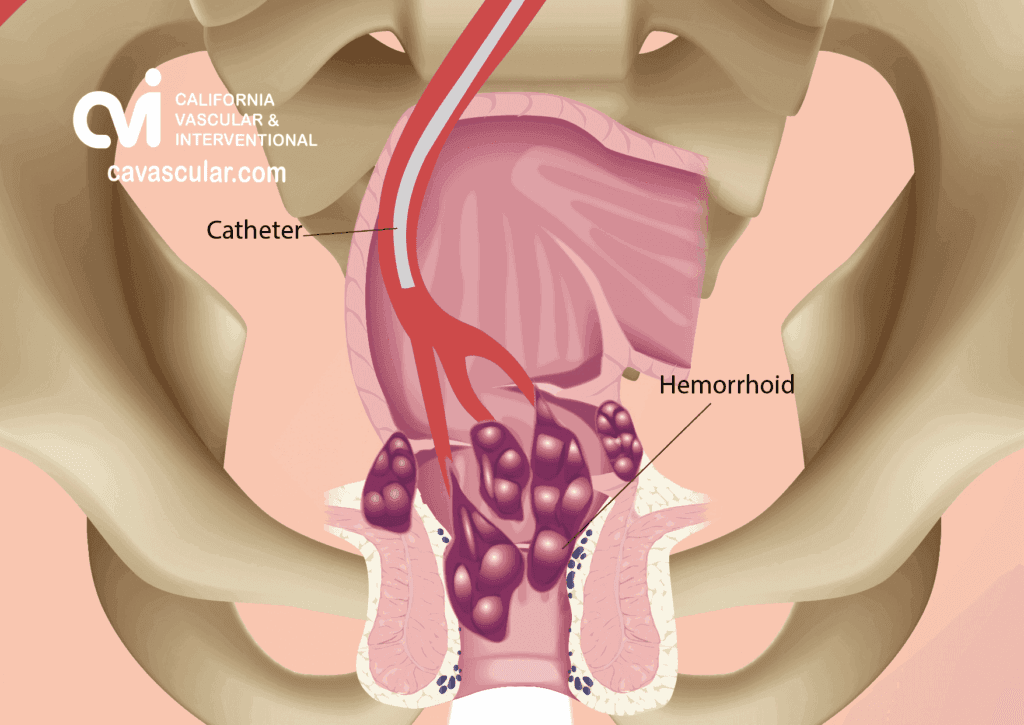
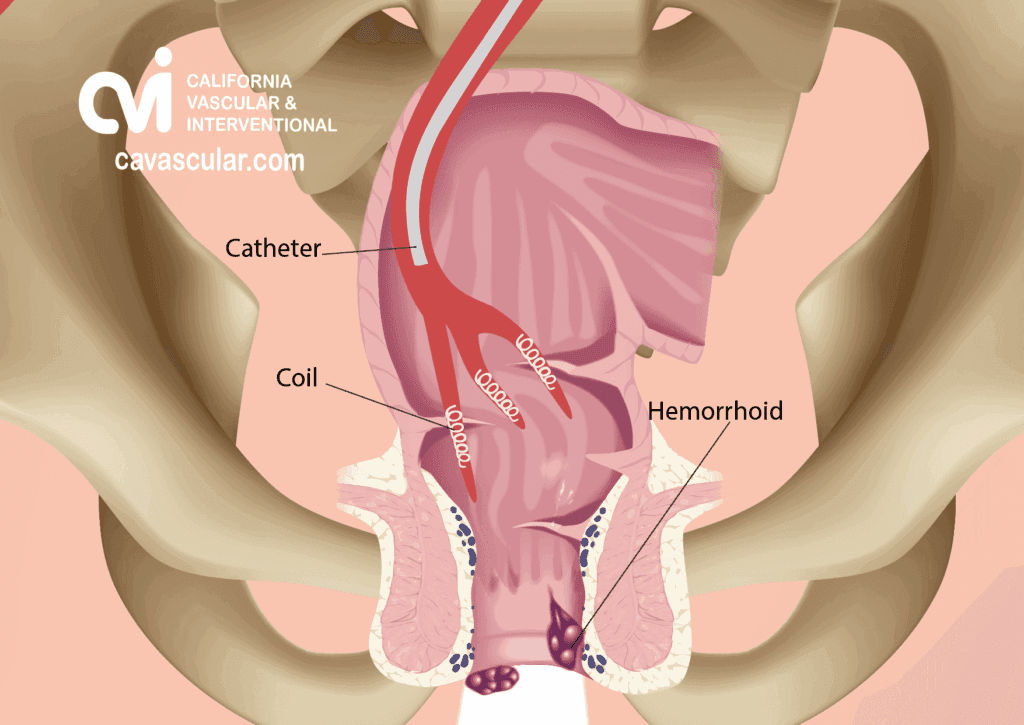
What is recovery like after hemorrhoid embolization?
It's an outpatient procedure with minimal downtime — most patients are discharged 1–2 hours afterward and go home the same day.
This is an outpatient procedure with minimal downtime. Patients are discharged home usually 1–2 hours after the procedure. Reports estimate a 75% patient satisfaction rate.1 This high rate of satisfaction is understandable, given the short procedure time, absence of any complications, and quick recovery time.1 In fact, patients can return home on the day of the treatment itself.1
Who is the best candidate for hemorrhoid embolization?
The ideal candidate has internal hemorrhoids that have failed other treatments from their gastroenterologist.
An ideal candidate for embolization is someone that has internal hemorrhoids that have failed other treatments by their gastroenterologist.
Is hemorrhoid artery embolization covered by insurance?
The procedure is typically covered by most insurance companies. Prior to the procedure you would require a thorough evaluation of your symptoms and medical records by Dr. Allaei to make sure you meet medical necessity for coverage.
Is hemorrhoid embolization better than surgery?
Hemorrhoid embolization offers several advantages over other treatment options. There are no surgical risks or alteration of the rectum. The patient’s ability to control anal movements (also known as continence) remains unaffected by the procedure.1 This technique does not create any rectal wounds.1 The anorectal region does not require any local care after the procedure. Most importantly, it is the least invasive technique for hemorrhoid treatment, on par with hemorrhoidal artery ligation.1
Overall, hemorrhoid embolization is a revolutionary hemorrhoid treatment that is highly successful and feasible for both doctors and patients. Its many advantages set it apart from conventional treatment options. More clinical trials will help to better assess the efficacy of this technique and ultimately take it to the masses.
The procedure succeeds on one thing: microwire precision
Hemorrhoid embolization succeeds or fails on the ability to navigate and selectively block the small superior rectal arteries without disturbing surrounding tissue — the single most demanding part of the procedure, and where Dr. Allaei excels.
This demands exceptional skill in microwire and microcatheter manipulation — the fine motor technique of steering sub-millimeter wires through tortuous, small-caliber vessels to reach precisely the right branch. Dr. Atabak Allaei, MD, is a dual board-certified Vascular & Interventional Radiologist and Diagnostic Radiologist who has performed over 5,000 image-guided procedures. His practice is built around complex, selective embolization across many organ systems — including the uterus, prostate, kidney, liver, lung, bowel, and musculoskeletal vessels — work that relies on the same refined microwire technique that makes hemorrhoid (rectal artery) embolization safe and effective. This depth of catheter-based experience allows him to access the small vessels that less-experienced operators often cannot reach.
Exceptional microwire skill
Steering sub-millimeter wires through tortuous, small-caliber vessels to the exact branch is the hardest part of HAE — and it’s the core of Dr. Allaei’s catheter-based practice.
5,000+ embolizations
A practice built around complex, selective embolization across the uterus, prostate, kidney, liver, lung, bowel, and musculoskeletal vessels — the same technique HAE relies on.
Fellowship-trained, dual board-certified
Vascular & Interventional Radiology fellowship at the Mallinckrodt Institute (Washington University / Barnes-Jewish), one of the foremost IR programs in the country.
Cedars-Sinai & UCI Health
Attending physician at Cedars-Sinai Medical Center and UCI Health, and Medical Director of California Vascular & Interventional.
He earned his medical degree from the State University of New York after graduating Summa Cum Laude in Biochemistry and Cell Biology from the University of California, San Diego. Because hemorrhoid embolization is a minimally invasive, image-guided procedure — not a surgery — it should be performed by a specialist trained specifically in catheter-directed embolization. Patients treated by Dr. Allaei receive that specialized expertise, along with the precision and attention to detail that small-vessel work requires.
Who performs your hemorrhoid embolization?
At California Vascular & Interventional, your hemorrhoid embolization is performed by Dr. Atabak Allaei — by the physician, with the small-vessel precision this procedure demands. Because HAE is image-guided rather than surgical, it should be performed by a specialist trained specifically in catheter-directed embolization.
Atabak Allaei, MD
Dual board-certified in Vascular & Interventional Radiology and Diagnostic Radiology, fellowship-trained at the Mallinckrodt Institute of Radiology (Washington University / Barnes-Jewish), with more than 5,000 image-guided procedures. Attending at Cedars-Sinai and UCI Health; Medical Director of California Vascular & Interventional.
Request an Appointment
Please note that although we strive to protect and secure our online communications, and use the security measures detailed in our Privacy Policy to protect your information, no data transmitted over the Internet can be guaranteed to be completely secure and no security measures are perfect or impenetrable. If you would like to transmit sensitive information to us, please contact us, without including the sensitive information, to arrange a more secure means of communication. By submitting this form you consent to receive text messages from CVI at the number provided. Msg & data rates may apply. Msg frequency varies. Unsubscribe at any time by replying STOP.
Hemorrhoid embolization: common questions
What is hemorrhoid embolization?
Is hemorrhoid embolization painful?
The procedure is performed using local anesthesia and sometimes mild IV sedation, and does not require general anesthesia. Because it works through a small artery in the wrist or groin rather than the anorectal area, most patients experience little to no discomfort — helped by Dr. Allaei’s extensive experience and imaging expertise.
How long does the procedure take?
Hemorrhoid embolization typically takes about one hour. Most patients are discharged home 1–2 hours after the procedure and can return to normal activity quickly.
How successful is hemorrhoid embolization?
Hemorrhoid embolization has a technical success rate of 90–100% and a clinical success rate ranging from 63–94% across published studies. Reported patient satisfaction is approximately 75%.
Who is a good candidate for hemorrhoid embolization?
The ideal candidate is someone with internal hemorrhoids that have not responded to other treatments, such as dietary changes, ointments, or rubber band ligation. A thorough evaluation by Dr. Allaei is important so you can understand how the procedure works and what to expect from the results.
Does hemorrhoid embolization affect bowel control?
No. The procedure preserves continence and does not create any rectal wounds. The anorectal region requires no local care afterward, which is a key advantage over surgical treatment.
Is hemorrhoid embolization covered by insurance?
The procedure is typically covered by most insurance companies. Prior to treatment, Dr. Allaei will review your symptoms and medical records to confirm medical necessity for coverage. Our billing department will then contact your insurance and submit these notes to obtain authorization.
What is recovery like after hemorrhoid embolization?
Recovery is quick, with minimal downtime. Patients usually go home the same day, about an hour after the procedure, and most resume normal activity shortly after.
Explore more image-guided treatments
Prostate Embolization (PAE)
Uterine Fibroid Embolization
Varicocele Embolization
All Conditions Treated
What is Interventional Radiology?
Meet Dr. Allaei
See if hemorrhoid embolization is right for you
If hemorrhoids haven’t responded to other treatments, embolization may offer relief without surgery or downtime. Request a consultation and Dr. Allaei will review your symptoms and medical records to determine whether you’re a candidate and confirm insurance coverage. Telehealth and in-person visits available across Los Angeles, Orange County and San Diego.