
Hysterosalpingography (HSG) is a diagnostic imaging study commonly used to assess the patency of the fallopian tubes and the shape of the uterine cavity.
Hysterosalpingography Study
Hysterosalpingography is a radiologic procedure that involves the injection of a contrast medium into the uterine cavity and fallopian tubes. This is typically done under fluoroscopic guidance. The contrast medium helps visualize the internal structures of the uterus and fallopian tubes on X-ray images, providing valuable information about their anatomy and function. This is done with a water-soluble contrast solution. For an oil-based contrast with poppy seed oil please read here regarding Lipiodol Oil.
It is important that you are not actively trying to get pregnant the month of the HSG study so that there is no risk to an early pregnancy with this test as there is x-ray imaging.1
Indications for Hysterosalpingography HSG Study
One of the primary indications for HSG is the assessment of infertility. It helps identify abnormalities in the uterine cavity, such as polyps or fibroids, and provides information about the patency of the fallopian tubes. Tubal obstruction is a significant factor in female infertility, and HSG can reveal whether the tubes are open or blocked. If the tubes are blocked pregnancy is not possible, these tubes would need to be opened first by a procedure called FTR. Read more here regarding the FTR procedure.
HSG is also valuable in evaluating congenital uterine anomalies, such as a bicornuate or septate uterus. These anomalies can affect fertility and increase the risk of pregnancy complications, and HSG provides crucial information for appropriate management.2
HSG Test: What to Expect
- Positioning: You will lie down on your back on an x-ray table, like a pelvic exam.
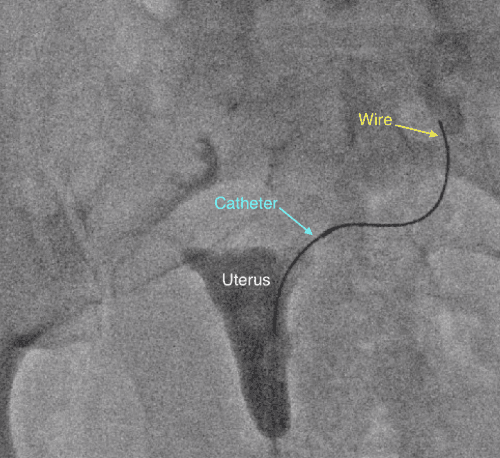
- Instrument placement: A speculum is placed into the vagina, like a PAP smear test. A thin catheter is inserted into the cervix opening.
- Contrast: A water soluble dye is injected through the catheter into the uterus. The dye helps visualize the shape and structure of the uterus and fallopian tubes on X-ray images.
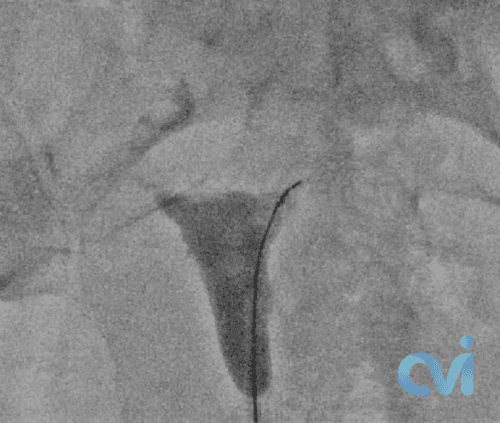
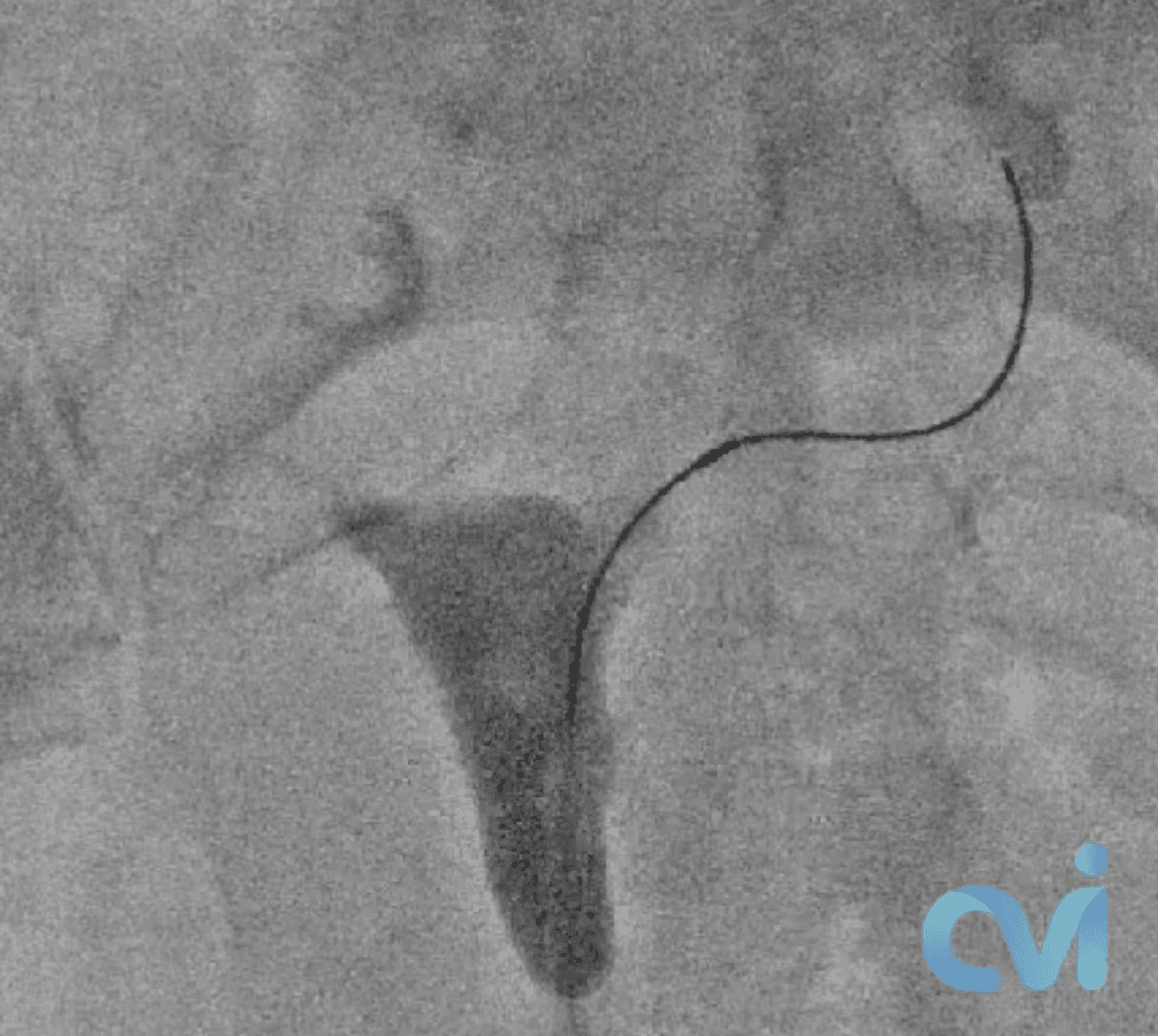
- X-ray Imaging: X-ray images are taken in real-time as the contrast dye fills the uterine cavity and then flows into the fallopian tubes. The images provide information about the presence of any abnormalities, such as uterine polyps, fibroids, or blockages in the fallopian tubes
- Evaluation: Our doctor will then evaluate the images and give you the results immediately after the test is completed. You will be provided the images and report to take with you to your fertility specialist.
- Post-procedure: After the procedure, the catheter is removed and you will apply a pad and get dressed.
HSG Study Interpretation
Normal HSG Findings
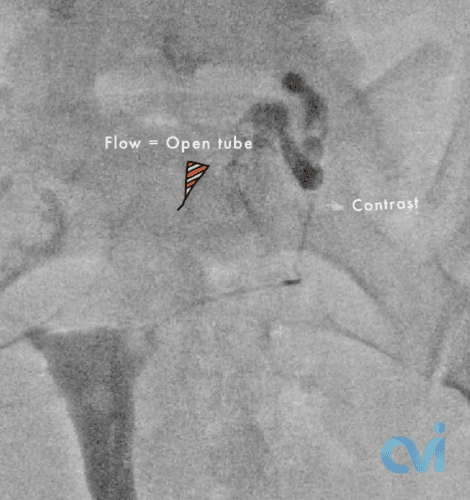
In a normal HSG, the contrast medium fills the uterine cavity and then spills out of the fallopian tubes into the pelvic cavity. This suggests that the tubes are patent, allowing the free flow of contrast medium. If both tubes are open then pregnancy should be able to proceed, if you are unsuccessful at pregnancy with open tubes, you can consider fallopian tube flushing procedure.
Abnormal HSG Findings
Abnormal findings in HSG may include uterine abnormalities like polyps or fibroids, as well as tubal abnormalities such as blockages or hydrosalpinx (fluid-filled fallopian tubes). These findings can provide insights into the underlying causes of infertility.3 For blocked tubes it is important to see where the tubes are blocked, which can determine how successful the FTR procedure can be at re-opening the tubes.
HSG and Female Fertility Assessment
Assessing Fallopian Tubal Patency
One of the crucial roles of HSG is the assessment of tubal patency. Tubal blockages are a common cause of female infertility, and HSG provides a direct and real-time evaluation of the fallopian tubes. The information obtained from HSG can guide further fertility investigations and treatment options, such as the FTR procedure for opening blocked tubes.
Infertility Treatment Planning
The findings from HSG play a significant role in determining the appropriate course of action for couples experiencing infertility. If tubal blockages are identified, assisted reproductive technologies (ART) such as an FTR procedure or in vitro fertilization (IVF) may be recommended as an alternative method for achieving pregnancy.4
HSG Limitations and Considerations
HSG False Positives and Negatives
Hysterosalpingography, while valuable, is not infallible. False positives and negatives can occur. For example, tubal spasm during the procedure may result in a false impression of blockage. Additionally, the sensitivity of HSG can be influenced by the experience of the radiologist performing the procedure. Make sure to have your HSG study performed by an experience diagnostic radiologist such as our doctor that not only performs HSGs but also treats the abnormal tubes with the FTR procedure.
HSG Patient Discomfort
The procedure can cause discomfort for some women, particularly during the injection of the contrast medium. Experiencing some cramping or pressure is normal.5
Hysterosalpingography HSG Study Cost
The HSG study should be performed by a Board-Certified Diagnostic Radiologist that specializes in women’s imaging to get the most accurate results. Additionally, the x-ray machine used should be up to date with the ability to zoom and window properly on the fallopian tubes for accurate evaluation. At our office the cost of the HSG study is $950 and this is inclusive of everything, including the pregnancy test and the consultation with the Radiologist.
This procedure is only done by our physician who also treats blocked and abnormal tubes and not by an assistant or non-physician provider like other offices. After the procedure our physician will review the results and images with you immediately after the study is completed, you do not need to wait for a report to be sent to your doctor like most facilities to find out the results. You will be sent a final report to take with you to your fertility specialist.
The HSG test is a valuable diagnostic tool in the assessment of female fertility. It provides real-time imaging of the uterine cavity and fallopian tubes, offering insights into potential causes of infertility. While it has some limitations, its role in guiding treatment decisions and contributing to the understanding of reproductive health is undeniable. If the tubes are blocked, it will show exactly where the tubes are blocked so that our doctor can determine if they can be opened.
The HSG test is a valuable diagnostic tool in the assessment of female fertility. It provides real-time imaging of the uterine cavity and fallopian tubes, offering insights into potential causes of infertility. While it has some limitations, its role in guiding treatment decisions and contributing to the understanding of reproductive health is undeniable. If the tubes are blocked, it will show exactly where the tubes are blocked so that our doctor can determine if they can be opened.
HSG Study Preparation
To prepare for an HSG study you will be prescribed an antibiotic that you will take for 5 days total. You will need to start the antibiotic two days prior to the procedure to prevent any infection. Dress in comfortable clothes on the day of the procedure as you will change into a gown. There may be some cramping during the test, so it is recommended that you take an Ibuprofen or Tylenol one hour prior to the test. There is no downtime, but you can expect some spotting and cramping afterwards. Make sure to bring a pad to apply after the procedure as some of the contrast fluid will leak out the first day and you will have some spotting for a few days.
Appointments are available via an online video telehealth platform or in person at one of the offices in Los Angeles, Orange County or San Diego, depending on the doctor’s availability. Contact Us Today. Why should you choose us? Read here.
References List:
- Swart P, Mol BW, van der Veen F, van Beurden M, Redekop WK, Bossuyt PM. The accuracy of hysterosalpingography in the diagnosis of tubal pathology: a meta-analysis. Fertil Steril. 1995;64(3):486-491.
- Mol BW, Collins JA, Wiegerinck MA, et al. The role of hysterosalpingography in the diagnosis of tubal pathology: the predictive value for in vitro fertilization of tubal patency tests. Hum Reprod. 1998;13(5):1266-1271.
- Mol BW, Swart P, Bossuyt PM, van Beurden M, van Der Veen F. Reproducibility of the interpretation of hysterosalpingography in the diagnosis of tubal pathology. Fertil Steril. 1996;66(6):1056-1060.
- Mol BW, Ankum WM, Bossuyt PM, Van der Veen F. Contraceptive induced amenorrhoea leads to decreased sensitivity of hysterosalpingography in the diagnosis of tubal pathology. BJOG. 1996;103(3):195-198.
- Ried K, Englehardt PF. Hysterosalpingo-contrast-sonography (HyCoSy) with SH U 454 (Echovist) in comparison with conventional hysterosalpingography with regard to patient preference. Hum Reprod. 1997;12(11):2444-2448.
The above information explains what is involved and the possible risks. It is not meant to be a substitute for informed discussion between you and your doctor, but can act as a starting point for such a discussion.






Setup an appointment
Your HSG, read by a specialist who opens blocked tubes.
An HSG is the real-time X-ray that shows whether your fallopian tubes are open — the central question behind it is fertility. Here it’s performed and read by Dr. Atabak Allaei, an interventional radiologist who not only diagnoses tubal blockage but treats it with FTR and tubal flushing. If a tube is blocked, you’re already with the doctor who can open it.
The HSG at a glance
A short, real-time X-ray study — about 15 minutes, no downtime.
Shows if each tube is open or blocked
Results & options reviewed by the doctor
Typical time on the X-ray table
Image-guided procedures by our physician
All-inclusive cash price
Includes a $350 results consultation, free
More than a scan — a diagnosis and a plan
At most facilities the HSG is performed and the images are then sent to your ordering doctor — you wait days, sometimes weeks, to find out what was seen. Here, the experience is built differently from the moment you walk in.
A leading specialist in opening blocked tubes
Our doctor reading your HSG is the same physician who performs FTR and tubal flushing — the procedures that actually re-open blocked tubes. Your study is interpreted by a specialist who treats tubal blockage every day and knows exactly what your result means for the path ahead.
Answers & a plan the same day
Our physician reviews your images with you immediately, in person, and explains what was found and what your options are. You take home a final report and images for your fertility specialist — instead of waiting for the images to be sent to your ordering doctor and relayed back days later.
One visit, no hidden fees
The same-day results consultation — a $350 value on its own — is included at no extra charge. The all-inclusive price covers the physician-performed study, that consultation, and your report, so there are no surprises after the fact. IV sedation, if you choose it for added comfort, is the one add-on billed separately.
An HSG (hysterosalpingography) test uses real-time X-ray and a water-soluble dye to check whether your fallopian tubes are open and your uterine cavity is normally shaped — the key question is usually fertility. At our center it’s performed and read by a specialist who also opens blocked tubes with FTR and tubal flushing, so your result and your options are reviewed with you the same day. The all-inclusive cash price is $950 and includes a $350 results consultation, free.
What is a hysterosalpingography (HSG) test?
An HSG is a diagnostic X-ray study that shows whether your fallopian tubes are open and whether the shape of your uterine cavity is normal.
Why would I need an HSG test?
Tubal blockage is a major factor in female infertility. If a tube is blocked, an egg and sperm can’t meet on that side, so pregnancy isn’t possible until the tube is opened. The HSG shows whether the tubes are open or blocked — and if they’re blocked, a minimally invasive procedure called fallopian tube recanalization (FTR) can often re-open them. Read more about the FTR procedure here.
What happens during the HSG test?
The whole study takes about 15 minutes. A thin catheter is placed through the cervix, dye is injected, and X-ray images are captured in real time.
Positioning
You lie on your back on the X-ray table, much like a routine pelvic exam.
Catheter placement
A speculum is placed — similar to a Pap smear — and a thin catheter is gently inserted into the cervical opening.
Contrast & live X-ray
A water-soluble dye is injected through the catheter. Real-time images show it fill the uterus and flow into the tubes.
Results on the spot
Our doctor reviews the images with you right away and gives you a report and images for your fertility specialist.
Afterward, the catheter is removed and you apply a pad and get dressed. Some of the dye leaks out the first day and light spotting and mild cramping for a day or two is normal.
What do the HSG results mean?
A normal result shows dye spilling freely from both tubes. An abnormal result shows where the dye stops — pinpointing a blockage or a uterine problem.
Open (patent) tubes
- Dye fills the uterine cavity evenly
- Dye spills freely out of both tubes into the pelvis
- Confirms the tubes are open so egg and sperm can meet
- If both are open but pregnancy isn't happening, a tube flushing procedure may help
Blockage or cavity issue
- Dye stops part-way — showing a blocked tube
- Shows exactly where the blockage sits
- May reveal polyps, fibroids or a hydrosalpinx
- Guides whether FTR can re-open the tube
Where the blockage sits matters: it helps our doctor judge how successful the FTR procedure is likely to be at re-opening the tube. Findings from the HSG guide the rest of your fertility plan — from FTR to assisted reproduction such as IVF.3–4
How accurate is the HSG — and does it hurt?
HSG is highly informative but not infallible, and operator experience matters. Most women feel cramping that settles quickly.
False positives and negatives can happen — for example, a temporary tubal spasm during the test can mimic a blockage. The quality of the result also depends on the experience of the radiologist and an up-to-date X-ray machine that can zoom and window properly on the tubes. That’s why it matters to have your HSG performed by an experienced diagnostic radiologist — ideally one who not only reads HSGs but also treats abnormal tubes with FTR.
As for comfort: the dye injection can cause cramping or pressure, similar to menstrual cramps, and it usually passes quickly. Taking ibuprofen or acetaminophen about an hour beforehand helps.5
How much does an HSG test cost?
At our office, the HSG study is an all-inclusive $950 cash price — performed by our physician, not an assistant — and it includes a $350 results consultation, free.
- The complete HSG study, read by a board-certified diagnostic radiologist
- A $350 results consultation, included free — your images and options reviewed in person, on the spot
- Performed by our physician who also treats blocked tubes with FTR — not an assistant or non-physician provider
- A final report and images to take to your fertility specialist, plus the pregnancy test — no hidden add-ons
The study should be done by a board-certified diagnostic radiologist who specializes in women’s imaging, on a modern X-ray machine, to get the most accurate read of the tubes. Rather than waiting for the images to be sent to your ordering doctor, our physician reviews them with you on the spot — if the tubes are blocked, you’ll see exactly where, so it can be determined whether they can be opened.
Please note: the $950 all-inclusive price does not include optional IV sedation. If you choose IV sedation for added comfort during the study, it is billed separately — ask our team for details when you schedule.
How do I prepare for the HSG study?
You'll start a short course of antibiotics two days before, take an over-the-counter pain reliever an hour before, and bring a pad for light spotting afterward.
- You'll be prescribed an antibiotic for 5 days total, starting two days before the test to prevent infection.
- Take an ibuprofen or acetaminophen about one hour before to ease cramping during the study.
- Wear comfortable clothes — you'll change into a gown.
- There's no downtime, but expect some spotting and cramping afterward; bring a pad, since some dye leaks out the first day.
Appointments are available via online video telehealth or in person at our offices in Los Angeles, Orange County or San Diego, depending on the doctor’s availability. Contact us today, or read about why patients choose us.
Request an Appointment
Please note that although we strive to protect and secure our online communications, and use the security measures detailed in our Privacy Policy to protect your information, no data transmitted over the Internet can be guaranteed to be completely secure and no security measures are perfect or impenetrable. If you would like to transmit sensitive information to us, please contact us, without including the sensitive information, to arrange a more secure means of communication. By submitting this form you consent to receive text messages from CVI at the number provided. Msg & data rates may apply. Msg frequency varies. Unsubscribe at any time by replying STOP.
Who performs the HSG study?
At California Vascular & Interventional Center, the HSG study is performed and read by Dr. Atabak Allaei, a board-certified diagnostic, vascular and interventional radiologist with extensive experience in women’s imaging. Because he also treats blocked tubes with FTR, he reads each study with an eye toward what can actually be done about an abnormal result — and reviews the images with you on the spot rather than sending a report days later.
Atabak Allaei, MD
Double board-certified in Vascular & Interventional Radiology and Diagnostic Radiology by the American Board of Radiology, with sub-specialty fellowship training and a proven track record of more than 5,000 image-guided procedures.
HSG test: common questions
What is an HSG test?
Hysterosalpingography (HSG) is a diagnostic X-ray study that checks whether the fallopian tubes are open and whether the uterine cavity has a normal shape. A water-soluble contrast dye is injected through a thin catheter into the uterus while real-time X-ray images show the dye filling the cavity and spilling out of the tubes, which confirms they are open.
How much does an HSG test cost?
Does an HSG test hurt?
When in my cycle should the HSG be done?
The HSG is scheduled in the first half of the menstrual cycle — after bleeding has stopped but before ovulation — and you should not be actively trying to get pregnant that month. This timing avoids any X-ray exposure to an early pregnancy.
How do I prepare for an HSG test?
You will take a short course of antibiotics starting two days before the test to prevent infection, and an over-the-counter pain reliever about one hour before to reduce cramping. Wear comfortable clothes, since you will change into a gown, and bring a pad for light spotting afterward.
What does a normal HSG result mean?
On a normal HSG, the contrast fills the uterine cavity and then spills freely out of both fallopian tubes into the pelvis. This shows the tubes are open (patent), so eggs and sperm can meet. If both tubes are open and pregnancy is still not occurring, a fallopian tube flushing procedure can be considered.
What happens if my tubes are blocked?
If the dye does not pass through one or both tubes, the tubes may be blocked. The HSG shows exactly where the blockage is, which helps determine whether a minimally invasive fallopian tube recanalization (FTR) can re-open them. Blocked tubes must be opened before natural pregnancy is possible.
How soon will I get my HSG results?
Immediately. The radiologist reviews the images with you right after the study is complete, so you do not have to wait for a report to be sent to your doctor. You are given a final report and the images to take to your fertility specialist.
References List:
- Swart P, Mol BW, van der Veen F, van Beurden M, Redekop WK, Bossuyt PM. The accuracy of hysterosalpingography in the diagnosis of tubal pathology: a meta-analysis. Fertil Steril. 1995;64(3):486-491.
- Mol BW, Collins JA, Wiegerinck MA, et al. The role of hysterosalpingography in the diagnosis of tubal pathology: the predictive value for in vitro fertilization of tubal patency tests. Hum Reprod. 1998;13(5):1266-1271.
- Mol BW, Swart P, Bossuyt PM, van Beurden M, van Der Veen F. Reproducibility of the interpretation of hysterosalpingography in the diagnosis of tubal pathology. Fertil Steril. 1996;66(6):1056-1060.
- Mol BW, Ankum WM, Bossuyt PM, Van der Veen F. Contraceptive induced amenorrhoea leads to decreased sensitivity of hysterosalpingography in the diagnosis of tubal pathology. BJOG. 1996;103(3):195-198.
- Ried K, Englehardt PF. Hysterosalpingo-contrast-sonography (HyCoSy) with SH U 454 (Echovist) in comparison with conventional hysterosalpingography with regard to patient preference. Hum Reprod. 1997;12(11):2444-2448.
The above information explains what is involved and the possible risks. It is not meant to be a substitute for informed discussion between you and your doctor, but can act as a starting point for such a discussion.
Related fertility & women's imaging
Find out if your tubes are open
An HSG is a quick, informative first step in the fertility work-up — and here you’ll get answers the same day, read by a physician who can also treat what the study finds. Telehealth and in-person visits are available across Los Angeles, Orange County and San Diego.