
Setup an appointment
Achilles pain that won't heal? Treat the vessels feeding it.
Achilles TAME at a glance
Image-guided embolization of the tendon’s abnormal vessels — walk out same day.
Typical procedure time
Back to normal activities — no boot
Everything surgery isn't
- No hospital
- Outpatient
- Low risk
- No surgery
- Image guided
- Successful
- No sutures
- Fast recovery
- Proven benefit
- No scars
- Targeted therapy
- Quick
Transarterial Micro Embolization (TAME) is a non-surgical, image-guided treatment for chronic Achilles tendinopathy. The chronic pain is driven partly by abnormal new blood vessels that grow around the degenerated tendon2,3 — through a small catheter in the wrist or groin, Dr. Allaei delivers an absorbable embolic that precisely blocks those vessels while preserving the tendon’s healthy blood supply. About 60 minutes, outpatient, no boot or stitches — you walk out the same day and return to normal activities within days, with studies reporting relief sustained at 24 months4 and no tendon ruptures.8
Small wrist/groin puncture only
Walk out the same day
When Achilles pain outlasts every treatment
For many patients, PT, rest, shockwave, and injections bring only partial relief — and surgery feels like a last resort. TAME is the third path.
Chronic Achilles tendinopathy is a painful, often limiting condition affecting the Achilles tendon at the back of the ankle. It commonly affects runners, active individuals, and those who spend long hours on their feet, leading to pain, stiffness, and swelling that worsens with activity and can significantly reduce quality of life. For many patients, traditional treatments like physical therapy, rest, shockwave therapy, and injections provide only partial relief, and surgery may feel like a last resort.
Transarterial Micro Embolization (TAME) is a non-surgical option for patients with chronic Achilles tendinopathy. TAME targets the abnormal blood vessels contributing to chronic inflammation and pain in the tendon, offering an alternative to surgery with less downtime and risk.
Find out in under a minute – no phone call needed.
What is chronic Achilles tendinopathy?
Overuse and repetitive stress leave the tendon thickened and painful — microtears, degeneration, and persistent low-grade inflammation.
The Achilles tendon connects your calf muscles to your heel bone, allowing you to walk, run, and push off during movement. Overuse, improper footwear, and repetitive stress can lead to tendinopathy, where the tendon becomes thickened and painful due to microtears, degeneration, and persistent low-grade inflammation.
Traditional treatments include:
- Activity modification and physical therapy for strengthening and flexibility
- Eccentric exercises
- Shockwave therapy
- Platelet-rich plasma (PRP) injections
- Surgical debridement for severe, persistent cases
The hard truth: while many patients improve with conservative care, up to 25–30% continue to have symptoms despite months of treatment,1 impacting their ability to remain active.
What is Achilles tendinopathy embolization?
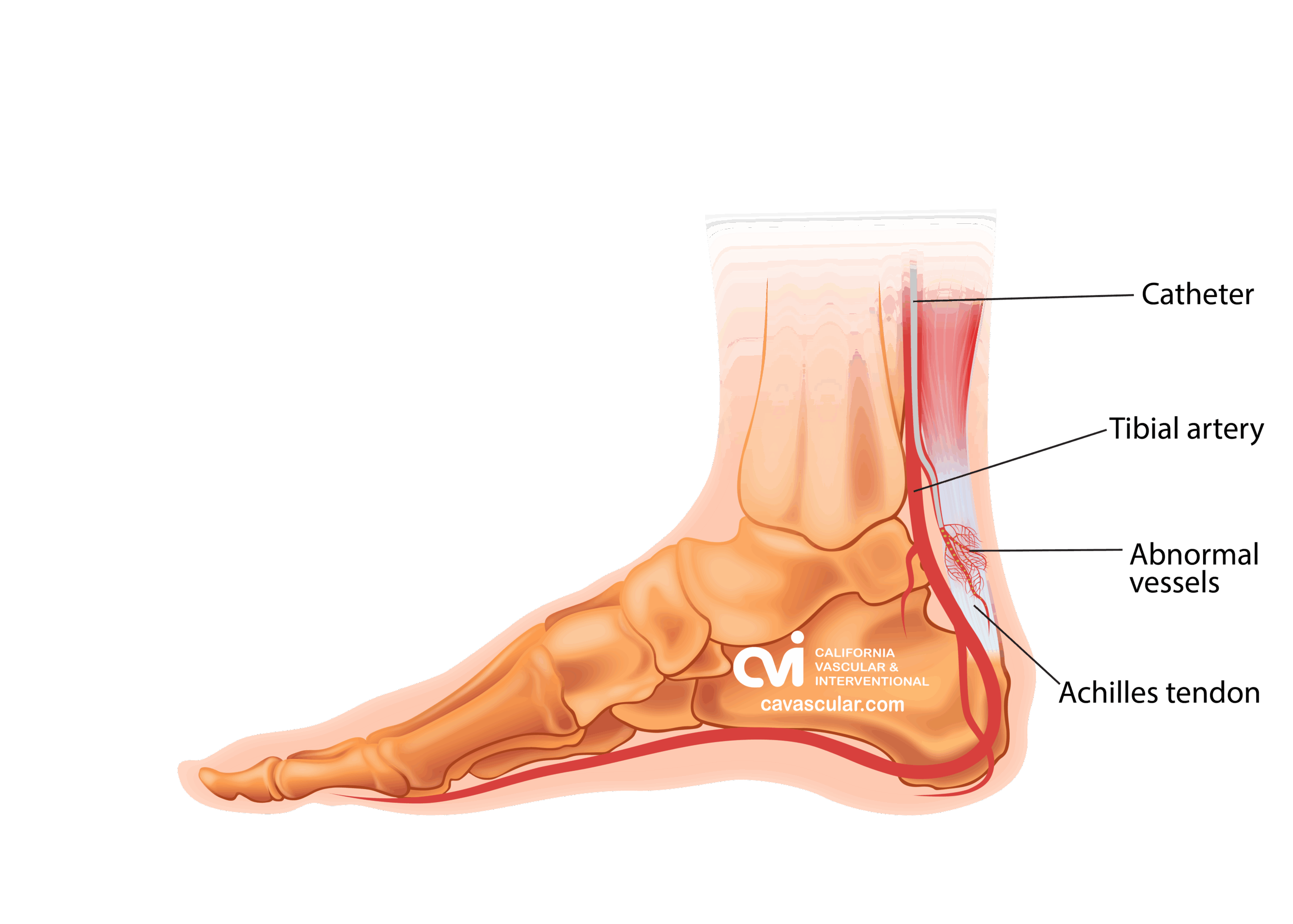
TAME blocks the abnormal neovascularization — the new small blood vessels around the degenerated tendon that drive chronic inflammation and pain.2,3
Transarterial Micro Embolization (TAME) is a minimally invasive, image-guided procedure performed by specially trained interventional radiologists, such as our specialist Dr. Allaei. It targets the abnormal neovascularization (new small blood vessels) that develop around the degenerated tendon and contribute to chronic inflammation and pain.2,3
What are the benefits of TAME for Achilles tendinopathy?
Research shows TAME can significantly reduce pain and improve function in patients who haven't responded to conservative treatments.
Research shows that TAME can significantly reduce pain and improve function in patients with chronic Achilles tendinopathy who have not responded to conservative treatments.
Key benefits include:
- Minimally invasive (no large incisions)
- Performed under local anesthesia with light sedation
- Outpatient procedure with same-day discharge
- Return to normal activities within days
- Lower risk compared to open surgery
- Preservation of the tendon structure
The durability question, answered: in a prospective study by Yu et al., patients experienced significant pain reduction and functional improvement at 24 months post-TAME, with no major complications reported.4
Achilles TAME vs surgery — how do they compare?
Surgery can work well — but costs you 6–12+ weeks in a boot.5 TAME gets you walking out the door the same day.
TAME Embolization
- Quicker recovery with less downtime
- No need for immobilization
- No large incisions or stitches
- Ability to return to walking and daily activities quickly
- Preserves the tendon structure
Surgical Debridement
- Removing degenerated tissue to stimulate healing
- A longer recovery (6–12 weeks or more)5
- Immobilization in a boot or brace
- Higher risks of infection or nerve injury
While long-term surgical outcomes can be excellent, TAME provides an effective, lower-risk alternative for patients seeking to avoid open surgery.
What are the results of Achilles embolization?
Recent studies show significant pain relief, MRI-confirmed reduction of abnormal vessels, and durable results at 2 years — with no tendon ruptures reported.6,7,8
Pain relief, proven on MRI
Demonstrated significant pain relief and improved function with TAME in chronic tendinopathy, with MRI evidence of reduced neovascularization.6
Relief that lasts
A study in Cardiovascular and Interventional Radiology found sustained symptom relief at 2-year follow-up in patients undergoing TAME for lower extremity tendinopathy.7
No ruptures reported
No tendon ruptures or significant complications have been reported in these studies, underscoring TAME’s safety profile.8
These outcomes suggest that TAME can be a valuable option for patients who have exhausted conservative therapies but wish to avoid surgery.
What should I expect during TAME?
Local anesthesia, a small wrist-or-groin catheter, absorbable particles into only the abnormal vessels — about 60 minutes, and you walk out.
Comfort first
You will receive local anesthesia with light sedation for comfort — no general anesthesia.
Small catheter, wrist or groin
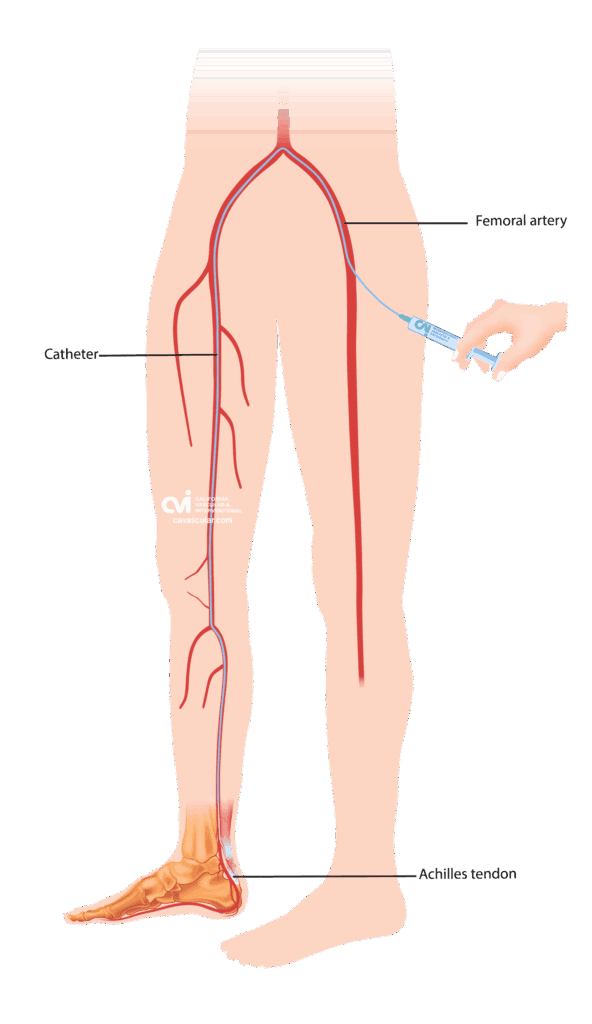
A small catheter is placed through the wrist or groin artery — no large incisions.
Navigate to the tendon's arteries
Under X-ray guidance, Dr. Allaei navigates to the arteries supplying your Achilles tendon.
Block the abnormal vessels & walk out
Tiny absorbable particles block the abnormal vessels. About 60 minutes — then you go home the same day, walking out of the center.
Who is a candidate for Achilles embolization?
If your Achilles pain has lasted more than 6 months and conservative care has failed, TAME may be your next step.
You may be a candidate for TAME if:
- You have had Achilles pain for more than 6 months
- Conservative treatments (PT, rest, injections) have failed
- MRI or ultrasound shows chronic tendinopathy
- You wish to avoid surgery and prefer a minimally invasive option
A consultation with our interventional radiologist who is experienced in musculoskeletal embolization is essential to determine if TAME is appropriate for your condition.
Care from a physician at the forefront of this field
At CVI Center, we specialize in cutting-edge, minimally invasive treatments for chronic pain — helping patients return to active lifestyles without the downtime and risks of surgery.
The physician other physicians learn from
Dr. Allaei regularly teaches other physicians in advanced embolization techniques — ensuring you receive care from a physician at the forefront of this evolving field. Embolizing an Achilles tendon means steering a hair-thin catheter into the small arteries of the ankle and delivering an absorbable embolic into only the abnormal vessels while sparing the tendon’s healthy blood supply. That level of catheter-and-wire skill is part rigorous training and part innate talent — a steadiness of hand and an ability to visualize the end result that can’t simply be taught. With over a decade of experience in image-guided procedures, Dr. Allaei has helped hundreds of patients with chronic tendon and joint pain achieve lasting relief while preserving their ability to remain active.
He teaches these techniques to other physicians
Dr. Allaei regularly instructs other physicians in advanced embolization — you’re treated by someone at the forefront of the field, not catching up to it.
Exceptional catheter-and-wire skill
Blocking only the abnormal vessels while sparing the tendon’s healthy supply takes a steadiness of hand that’s part training, part innate talent.
Hundreds of tendon & joint patients
Over a decade of image-guided experience across the Achilles, plantar fascia, knee, shoulder, and elbow — lasting relief that keeps patients active.
Personal, no-pressure care
Personalized, compassionate care, clear communication, and a candidacy review of your MRI or ultrasound before any decision is made.
Request an Appointment
Please note that although we strive to protect and secure our online communications, and use the security measures detailed in our Privacy Policy to protect your information, no data transmitted over the Internet can be guaranteed to be completely secure and no security measures are perfect or impenetrable. If you would like to transmit sensitive information to us, please contact us, without including the sensitive information, to arrange a more secure means of communication. By submitting this form you consent to receive text messages from CVI at the number provided. Msg & data rates may apply. Msg frequency varies. Unsubscribe at any time by replying STOP.
Who performs your Achilles embolization?
Atabak Allaei, MD
With over a decade of experience in image-guided procedures, Dr. Allaei has helped hundreds of patients with chronic tendon and joint pain achieve lasting relief while preserving their ability to remain active. His musculoskeletal embolization practice spans the Achilles tendon, plantar fascia, knee (GAE), shoulder (ACE), and elbow (TAME) — and he regularly teaches other physicians in advanced embolization techniques. All procedures are physician-performed. Consultations by telehealth or in person in Los Angeles, Orange County, and San Diego.
Achilles embolization: common questions
What is chronic Achilles tendinopathy?
Chronic Achilles tendinopathy is a painful, often limiting condition affecting the Achilles tendon at the back of the ankle — the tendon that connects your calf muscles to your heel bone and lets you walk, run, and push off. Overuse, improper footwear, and repetitive stress can cause the tendon to become thickened and painful due to microtears, degeneration, and persistent low-grade inflammation. It commonly affects runners, active individuals, and people who spend long hours on their feet, with pain, stiffness, and swelling that worsen with activity.
Why won't my Achilles tendinopathy heal with physical therapy?
Many patients improve with conservative care — activity modification, physical therapy, eccentric exercises, shockwave therapy, or PRP injections — but up to 25–30% continue to have symptoms despite months of treatment. In chronic tendinopathy, abnormal new blood vessels (neovascularization) develop around the degenerated tendon and contribute to persistent inflammation and pain — a vessel problem that exercise-based treatment alone doesn’t address, and one that TAME is designed to target directly.
What is Achilles tendinopathy embolization (TAME)?
Transarterial Micro Embolization (TAME) is a minimally invasive, image-guided, non-surgical treatment for chronic Achilles tendinopathy. Through a catheter inserted via a small puncture in the wrist or groin, the interventional radiologist advances into the arteries supplying the Achilles tendon and injects an absorbable embolic, precisely delivered to block the abnormal vessels. This reduces inflammation and pain while preserving the healthy blood supply to the tendon and the tendon structure itself.
How is TAME performed, and how long does it take?
You receive local anesthesia with light sedation for comfort. A small catheter is placed through the wrist or groin artery, and under X-ray guidance it is navigated to the arteries supplying your Achilles tendon, where tiny absorbable particles are injected to block the abnormal vessels. The procedure typically takes about 60 minutes, and you go home the same day — walking out of the center.
What is recovery like after Achilles embolization?
Recovery is quick: it’s an outpatient procedure with same-day discharge, no immobilization in a boot or brace, no large incisions or stitches, and a return to normal activities within days — compared with 6–12 weeks or more of recovery and immobilization after surgery.
How does TAME compare to Achilles surgery?
Surgical treatment often involves removing degenerated tissue and stimulating healing, but requires a longer recovery (6–12 weeks or more), immobilization in a boot or brace, and carries higher risks of infection or nerve injury. TAME offers quicker recovery with less downtime, no immobilization, no large incisions or stitches, and a rapid return to walking and daily activities. While long-term surgical outcomes can be excellent, TAME provides an effective, lower-risk alternative for patients seeking to avoid open surgery.
How effective and safe is TAME for Achilles tendinopathy?
Recent studies highlight both effectiveness and safety. Okuno et al. demonstrated significant pain relief and improved function, with MRI evidence of reduced neovascularization. A study in Cardiovascular and Interventional Radiology found sustained symptom relief at 2-year follow-up, and a prospective study by Yu et al. reported significant pain reduction and functional improvement at 24 months post-TAME with no major complications. Importantly, no tendon ruptures or significant complications have been reported in these studies.
Am I a candidate for Achilles tendinopathy embolization?
You may be a candidate for TAME if you have had Achilles pain for more than 6 months, conservative treatments (physical therapy, rest, injections) have failed, MRI or ultrasound shows chronic tendinopathy, and you wish to avoid surgery and prefer a minimally invasive option. A consultation with an interventional radiologist experienced in musculoskeletal embolization is essential to determine if TAME is appropriate for your condition.
References:
- Maffulli, N. et al. (2003). “Current concepts review: Achilles tendinopathy.” Journal of Bone and Joint Surgery, 85(7), 1220-1230.
- Yu, K. et al. (2016). “Current status of transcatheter arterial embolization for musculoskeletal conditions.” Cardiovascular and Interventional Radiology, 39(7), 903-910.
- Hata, J. et al. (2014). “Transcatheter arterial embolization for the treatment of chronic pain in Achilles tendinopathy.” Journal of Vascular and Interventional Radiology, 25(1), 131-138.
- Yu, K. et al. (2021). “Two-year outcomes after transcatheter arterial embolization for chronic Achilles tendinopathy.” Journal of Vascular and Interventional Radiology, 32(9), 1281-1288.
- Paavola, M. et al. (2000). “Surgical treatment for chronic Achilles tendinopathy: a prospective seven-month follow-up study.” British Journal of Sports Medicine, 34(5), 392-395.
- Okuno, Y. et al. (2013). “Embolization of neovessels in tendinopathy reduces pain: a prospective study.” Radiology, 267(2), 584-592.
- Okuno, Y. et al. (2016). “Clinical outcomes of transcatheter arterial embolization for lower extremity tendinopathy.” Cardiovascular and Interventional Radiology, 39(11), 1763-1770.
- Little, C. et al. (2022). “Safety of transcatheter arterial embolization for chronic tendinopathy: a systematic review.” Skeletal Radiology, 51(1), 15-23.
Explore related embolization treatments
Plantar Fasciitis
Knee Osteoarthritis (GAE)
Frozen Shoulder (ACE)
Tennis Elbow (TAME)
What is Interventional Radiology?
Meet Our Specialist
Get back on your feet — without surgery
If chronic Achilles tendinopathy is limiting your activity and quality of life, and conservative treatments have not provided relief, Transarterial Micro Embolization may be the solution you need. Request a consultation and Dr. Allaei will review your MRI or ultrasound and tell you honestly whether TAME is right for you — by telehealth or in person in Los Angeles, Orange County or San Diego.