
Frozen Shoulder ACE Treatment
- No hospital
- No surgery
- No sutures
- No scars
- Outpatient
- Image guided
- Fast recovery
- Targetted therapy
- Low risk
- Successful
- Proven benefit
- Quick
Frozen Shoulder
Adhesive capsulitis, or frozen shoulder, is a debilitating problem of the shoulder joint, affecting 2-5% of the population.1 This condition involves a significant reduction in the active and passive range of motion of the patient’s shoulder joint.1 Frozen shoulder is more often observed in women than in men.1 Patients with thyroid disorders and diabetes are also more likely to suffer from frozen shoulder.2
Concerningly, the incidence of frozen shoulder in the general population has been increasing.1 This makes it all the more important to understand this disorder in a more comprehensive way.
Adhesive capsulitis, or frozen shoulder, is a debilitating problem of the shoulder joint, affecting 2-5% of the population.1 This condition involves a significant reduction in the active and passive range of motion of the patient’s shoulder joint.1 Frozen shoulder is more often observed in women than in men.1 Patients with thyroid disorders and diabetes are also more likely to suffer from frozen shoulder.2
Concerningly, the incidence of frozen shoulder in the general population has been increasing.1 This makes it all the more important to understand this disorder in a more comprehensive way.
Frozen Shoulder: Symptoms
As mentioned earlier, people with a frozen shoulder experience a decrease in their shoulder’s range of motion.1,3 Additionally, they experience pain whenever the affected shoulder joint comes into use.1,3 The intensity of these symptoms depends on the phase of the disorder.
Frozen shoulder has three phases, starting with the ‘freezing’ phase, which is when shoulder pain starts along with a gradual decrease in the joint’s range of motion.1 Next comes the ‘frozen’ phase, during which the pain gradually subsides and the stiffness of the joint plateaus.1 The third phase is called ‘thawing’, during which patients experience an improvement in joint motion.1
Frozen Shoulder: Diagnosis
The diagnosis of frozen shoulder takes place through physical examination and diagnostic imaging.3,4 However, depending on which phase the condition is in, frozen shoulder may be challenging to diagnose.3 Magnetic resonance imaging (MRI) presents substantial evidence to establish the occurrence of frozen shoulder.4 Specifically, MRI findings such as joint capsule thickness, scar tissue formation, and edema help confirm a frozen shoulder diagnosis.4
Frozen Shoulder: Treatment Options
Physical therapy is commonly used to manage frozen shoulder, alongside pharmaceutical interventions such as corticosteroid injections or non-steroidal anti-inflammatory drugs.2,3 Hydrodilatation and extracorporeal shockwave therapy are some other non-surgical strategies that help manage frozen shoulder.3.4
However, when non-surgical options fail to work within the first year of treatment, surgical intervention becomes necessary.4 It is important to note that surgical options, such as manipulation under anesthesia and arthroscopic capsular release, are very invasive and associated with possible complications, including fractures and axillary nerve injury.4
Frozen Shoulder: Adhesive Capsulitis Embolization (ACE)
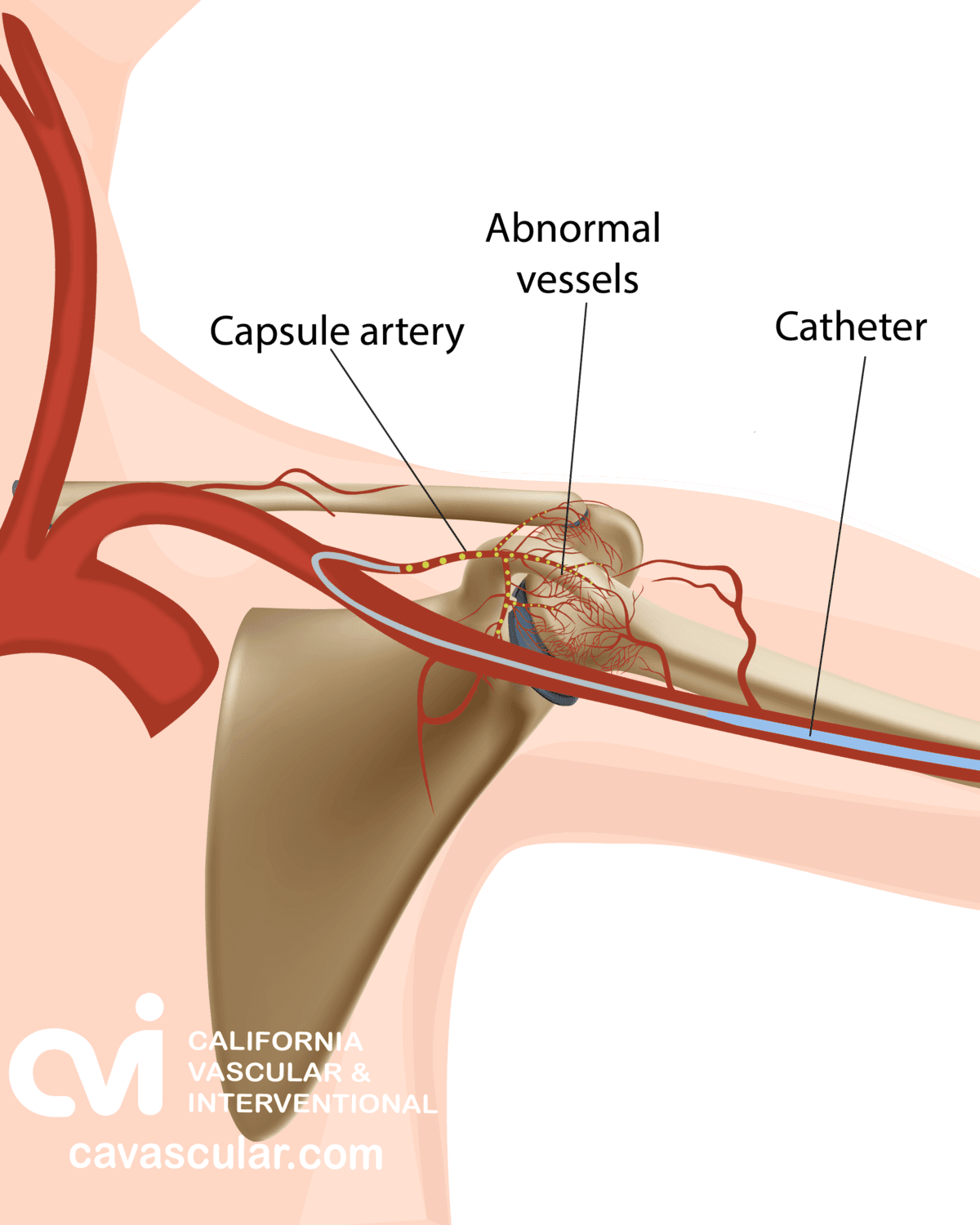
The aim is to block the blood flow into inflamed areas and ease the pain.6,7 Images prior to treatment typically demonstrated abnormally enlarged blood vessels around the shoulder joint, which disappear immediately following the treatment. Indeed, this method not only reduces pain but also improves shoulder function in a safe and effective manner.5,6
In fact, improvements in the shoulder joint’s range of motion can occur as early as 24 hours after embolization.7 In some cases, however, further physical therapy is required after embolization in order to gain proper joint function.7
Frozen Shoulder Embolization: Procedure
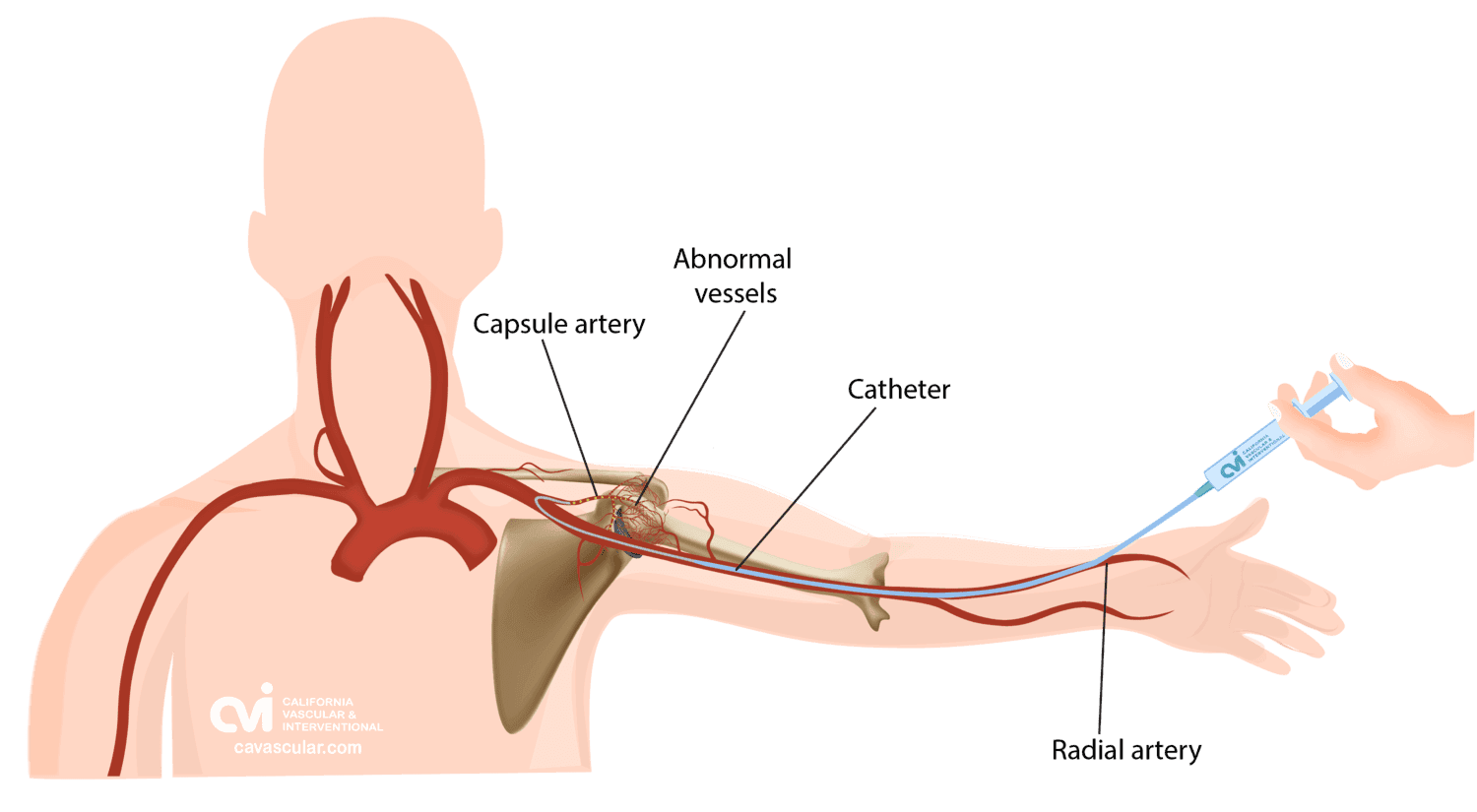
Selective embolization is an outpatient non-surgical procedure with minimal downtime. The procedure is done in an outpatient state of the art center where our interventional radiologist performs the treatment through a tiny tube called a catheter. This procedure can be performed by either placing the catheter in an artery at the top of the leg (called a femoral approach) or by placing it into an artery in the lower arm (called a radial approach). The two methods are illustrated below.
The patient is given a local and topical anesthetic to numb the skin and a mild sedative, so that the procedure is not painful. A sophisticated X-ray machine that creates moving pictures in “real” time enables the doctor to see the catheter as it is guided through the blood vessels and into the appropriate arteries.
Embolization of the affected arteries is completed by injecting an antibiotic and particles into blood vessel through the catheter. The abnormal arteries become blocked with the particles, resulting in a lack of blood flow to the abnormal tissues of the joint reducing inflammation and pain.
Patients are discharged one to two hours after the treatment. As the procedure is minimally invasive, the incidence of any complications is very low. Patients might experience bruising or pain at the injection site. Some rare complications include allergic reactions, infection, bleeding/bruising, skin irritation.

Frozen Shoulder Embolization: Preparation and Downtime
The embolization is an outpatient procedure that is about 60 minutes. To prepare, patients are asked not to eat or drink anything after midnight the day of their procedure as a mild sedative may be given to help you relax. Patients are discharged 1-2 hours after the procedure. Most patients fly into Los Angeles the day prior to their procedure. Some patients may take ibuprofen for a couple of days otherwise there is minimal to no discomfort after the treatment. We recommend waiting a day before getting on a flight due to the light sedation you may have been given.
Adhesive Capsulitis Embolization (ACE): Results
ACE has proven to be a successful method to treat a frozen shoulder. According to one study, pain scores, as measured on the Visual Analog Scale, decreased by 35.6% within a month of ACE.6 Six months after the procedure, the pain levels had decreased by 69.6%.6
Another study reported a complete recovery, without any recurrence, in 92.5% of the patients treated with ACE.7 Another 5% of the patients exhibited partial recovery.7 This study also reported that ACE led to an average 67% improvement in the patients’ shoulder flexion and a 79% improvement in their abduction motion.7
Frozen Shoulder: What Should I Know
Frozen shoulder is a condition that causes significant morbidity in patients, sometimes for years at a stretch and has potential to cause chronic damage. Non-surgical treatment approaches are not always effective, and surgical methods are invasive and pose risks of complications. Adhesive capsulitis embolization (ACE) is an effective outpatient treatment for frozen shoulder, achieving both pain reduction and joint functionality while ensuring safety and effectiveness.5 If you are suffering from a frozen shoulder, contact us to setup a consultation with our specialist to discuss the risks and efficacies of all treatment options before making a decision.
Appointments are available via an online video telehealth platform or in person at one of the offices in Los Angeles, Orange County or San Diego, depending on the doctor’s availability. Contact Us Today. Why should you choose us? Read here.
References:
- Cho CH, Bae KC, Kim DH. Treatment strategy for frozen shoulder. Clinics in Orthopedic Surgery. 2019; 11(3):249-57.
- Mertens MG, Meeus M, Verborgt O, Vermeulen EH, Schuitemaker R, Hekman K, van der Burg DH, Struyf F. An overview of effective and potential new conservative interventions in patients with frozen shoulder. Rheumatology International. 2021; 6:1-2.
- Millar NL, Meakins A, Struyf F, Willmore E, Campbell AL, Kirwan PD, Akbar M, Moore L, Ronquillo JC, Murrell GA, Rodeo SA. Frozen shoulder. Nature Reviews Disease Primers. 2022; 8(1):1-6.
- Redler LH, Dennis ER. Treatment of adhesive capsulitis of the shoulder. JAAOS-Journal of the American Academy of Orthopaedic Surgeons. 2019; 27(12):e544-54.
- Sajan A, Isaacson A, Bagla S. Adhesive capsulitis embolization: a case of particle embolization for refractory shoulder pain secondary to adhesive capsulitis. Journal of Radiology Nursing. 2021; 40(2):136-8.
- Bagla S, Nagda S, Piechowiak R, Orlando J, Sajan A, Isaacson A. Results from a United States Investigational Device Study of Adhesive Capsulitis Embolization in the Treatment of Shoulder Pain: The Adhesive Capsulitis Embolization Study. Journal of Vascular and Interventional Radiology. 2022; 33(2):177-82.
- Fernandez Martinez AM, Baldi S, Alonso-Burgos A, López R, Vallejo-Pascual ME, MT CM, Mauriz JL. Mid-Term Results of Transcatheter Arterial Embolization for Adhesive Capsulitis Resistant to Conservative Treatment. Cardiovascular and Interventional Radiology. 2020.
The above information explains what is involved and the possible risks. It is not meant to be a substitute for informed discussion between you and your doctor, but can act as a starting point for such a discussion.
Setup an appointment
Don't spend years waiting for your shoulder to thaw.
Frozen shoulder ACE at a glance
Image-guided embolization — about 60 minutes, home the same day.
Complete recovery, no recurrence7
Outpatient · discharged in 1–2 hrs
Everything surgery isn't
- No hospital
- Outpatient
- Low risk
- No surgery
- Image guided
- Successful
- No sutures
- Fast recovery
- Proven benefit
- No scars
- Targeted therapy
- Quick
Adhesive capsulitis embolization (ACE) is a non-surgical, outpatient treatment for frozen shoulder. Through a tiny catheter guided by real-time X-ray, Dr. Allaei blocks the abnormally enlarged blood vessels feeding the inflamed joint — the vessels disappear immediately, easing pain and restoring function. The procedure takes about 60 minutes, you’re home in 1–2 hours with no scars or sutures, motion can improve as early as 24 hours,7 and studies report 92.5% complete recovery without recurrence.7
Catheter-based, no incisions
Motion gains as early as 24 hrs7
What is frozen shoulder?
Adhesive capsulitis — frozen shoulder — is a debilitating problem of the shoulder joint affecting 2–5% of the population,1 and its incidence is increasing.1
Adhesive capsulitis, or frozen shoulder, is a debilitating problem of the shoulder joint, affecting 2-5% of the population.1 This condition involves a significant reduction in the active and passive range of motion of the patient’s shoulder joint.1 Frozen shoulder is more often observed in women than in men.1 Patients with thyroid disorders and diabetes are also more likely to suffer from frozen shoulder.2
Find out in under a minute – no phone call needed.
What are the symptoms of frozen shoulder?
A shrinking range of motion and pain whenever the shoulder is used1,3 — moving through three phases that can stretch on for years.
As mentioned earlier, people with a frozen shoulder experience a decrease in their shoulder’s range of motion.1,3 Additionally, they experience pain whenever the affected shoulder joint comes into use.1,3 The intensity of these symptoms depends on the phase of the disorder.
Freezing
The catch: frozen shoulder causes significant morbidity in patients, sometimes for years at a stretch, and has the potential to cause chronic damage. You don't have to wait out the thaw.
How is frozen shoulder diagnosed?
Through physical examination and diagnostic imaging — with MRI providing substantial confirming evidence.3,4
What are the treatment options for frozen shoulder?
Conservative care comes first — but when it fails, the traditional next step is invasive surgery.4 ACE offers a third path.
Physical therapy is commonly used to manage frozen shoulder, alongside pharmaceutical interventions such as corticosteroid injections or non-steroidal anti-inflammatory drugs.2,3 Hydrodilatation and extracorporeal shockwave therapy are some other non-surgical strategies that help manage frozen shoulder.3,4
Embolization (ACE)
- Outpatient — about 60 minutes
- No incisions, sutures, scars, or hospital
- Local anesthetic + mild sedative — not painful
- Discharged 1–2 hours after treatment
- Motion can improve as early as 24 hours7
- Very low incidence of complications
MUA / Capsular Release
- Manipulation under anesthesia
- Arthroscopic capsular release
- Very invasive procedures4
- Possible complications include fractures4
- Risk of axillary nerve injury4
- Considered when conservative care fails4
What is adhesive capsulitis embolization (ACE)?
ACE blocks the blood flow into the inflamed areas of the joint6,7— the abnormally enlarged vessels disappear immediately, and pain and function both improve.5,6
The aim is to block the blood flow into inflamed areas and ease the pain.6,7 Images prior to treatment typically demonstrated abnormally enlarged blood vessels around the shoulder joint, which disappear immediately following the treatment. Indeed, this method not only reduces pain but also improves shoulder function in a safe and effective manner.5,6
How is frozen shoulder embolization performed?
A tiny catheter, real-time X-ray guidance, and targeted particles — outpatient, minimal downtime, discharged in 1–2 hours.
Numbing & mild sedation
Tiny catheter, two access options
The catheter is placed in an artery at the top of the leg (femoral) or the lower arm (radial) — no incisions.
Real-time image guidance
A sophisticated X-ray machine creating moving pictures in “real” time guides the catheter into the appropriate arteries.
Embolize & go home
An antibiotic and particles block the abnormal arteries — reducing inflammation and pain. Discharged 1–2 hours later.
The patient is given a local and topical anesthetic to numb the skin and a mild sedative, so that the procedure is not painful. A sophisticated X-ray machine that creates moving pictures in “real” time enables the doctor to see the catheter as it is guided through the blood vessels and into the appropriate arteries.
Embolization of the affected arteries is completed by injecting an antibiotic and particles into blood vessel through the catheter. The abnormal arteries become blocked with the particles, resulting in a lack of blood flow to the abnormal tissues of the joint reducing inflammation and pain.
Patients are discharged one to two hours after the treatment. As the procedure is minimally invasive, the incidence of any complications is very low. Patients might experience bruising or pain at the injection site. Some rare complications include allergic reactions, infection, bleeding/bruising, skin irritation.
What are the preparation and downtime?
About 60 minutes in and out the same day — most out-of-town patients fly into Los Angeles the day before and head home the day after.
The embolization is an outpatient procedure that is about 60 minutes. To prepare, patients are asked not to eat or drink anything after midnight the day of their procedure as a mild sedative may be given to help you relax. Patients are discharged 1-2 hours after the procedure. Most patients fly into Los Angeles the day prior to their procedure. Some patients may take ibuprofen for a couple of days otherwise there is minimal to no discomfort after the treatment. We recommend waiting a day before getting on a flight due to the light sedation you may have been given.
Traveling for care? Our coordinators arrange consultations by telehealth first, so out-of-town patients typically need just two nights in Los Angeles — arrive the day before, treated in about an hour, fly home the day after.
How successful is ACE for frozen shoulder?
Studies report 92.5% complete recovery without recurrence,7 pain down 69.6% at six months,6 and major gains in motion.7
ACE has proven to be a successful method to treat a frozen shoulder. According to one study, pain scores, as measured on the Visual Analog Scale, decreased by 35.6% within a month of ACE.6 Six months after the procedure, the pain levels had decreased by 69.6%.6
Complete recovery, without any recurrence7
Average improvement in shoulder flexion7
Improvement in abduction motion7
The consultation that puts every option on the table
Frozen shoulder can cause years of morbidity and chronic damage — and the smartest first step is one conversation where every treatment option is weighed honestly.
Patients fly into Los Angeles for this procedure
Joint embolization is a precise, catheter-based skill — steering a hair-thin wire through a 3D vascular tree on a 2D X-ray is part rigorous training, part innate talent — and Dr. Atabak Allaei has built a practice patients travel for. Dual board-certified in interventional radiology and imaging, fellowship-trained at the Mallinckrodt Institute (Washington University/Barnes-Jewish), on staff at Cedars-Sinai and UCI Health, with over 5,000 image-guided procedures, he performs musculoskeletal embolization across the shoulder, elbow, knee, and foot in a state-of-the-art outpatient center — no hospital required. Most out-of-town patients arrive the day before, are treated in about an hour, and fly home the day after. Your first step is simpler still: a consultation, by telehealth or in person, where every option is discussed before any decision is made.
A destination practice
Most out-of-town patients fly into Los Angeles the day prior — two nights, one hour of treatment, home the next day.
Exceptional wire skills, Mallinckrodt-trained
5,000+ image-guided procedures
Deep embolization experience across the body — shoulder (ACE), tennis elbow (TAME), knee (GAE), and plantar fasciitis.
A no-pressure consultation
Appointments are available via an online video telehealth platform or in person at one of the offices in Los Angeles, Orange County or San Diego, depending on the doctor’s availability. Contact Us Today. Why should you choose us? Read here.
Request an Appointment
Please note that although we strive to protect and secure our online communications, and use the security measures detailed in our Privacy Policy to protect your information, no data transmitted over the Internet can be guaranteed to be completely secure and no security measures are perfect or impenetrable. If you would like to transmit sensitive information to us, please contact us, without including the sensitive information, to arrange a more secure means of communication. By submitting this form you consent to receive text messages from CVI at the number provided. Msg & data rates may apply. Msg frequency varies. Unsubscribe at any time by replying STOP.
Who performs your frozen shoulder embolization?
At California Vascular & Interventional, your ACE procedure is performed by Dr. Atabak Allaei — by the physician, start to finish, in a state-of-the-art outpatient center. He is one of the most experienced and trusted embolization specialists, and joint embolization is a core focus of his practice.
It matters who holds the wire. Embolizing a shoulder means steering a hair-thin catheter and wire through small, branching arteries — reading a flat, 2D X-ray while navigating a 3D vascular tree, and blocking only the abnormal vessels while sparing normal circulation. That level of catheter-and-wire skill is part rigorous training and part innate talent — a steadiness of hand and an ability to visualize the end result that can’t simply be taught. Dr. Allaei refined that aptitude through fellowship training at the prestigious Mallinckrodt Institute of Radiology at Washington University/Barnes-Jewish Medical Center, and through thousands of complex embolizations — chemoembolization, radioembolization, and tumor work in high-stakes organs — before applying it to joints. He serves on staff at Cedars-Sinai Medical Center in Beverly Hills and UCI Health, and is the Medical Director of California Vascular & Interventional.
Atabak Allaei, MD
Dual board-certified in Vascular & Interventional Radiology and Diagnostic Imaging — a combination that pairs detailed diagnostic interpretation with precise procedural treatment. Fellowship-trained at the Mallinckrodt Institute of Radiology (Washington University/Barnes-Jewish), on staff at Cedars-Sinai and UCI Health, and Medical Director of CVI, he has performed more than 5,000 image-guided procedures. Respected for his technical skill, careful imaging evaluation, and ability to manage challenging cases, his musculoskeletal embolization practice spans the shoulder (ACE), elbow (TAME), knee (GAE), and foot — precision catheter work that patients travel to Los Angeles for. Consultations by telehealth or in person in Los Angeles, Orange County, and San Diego.
Frozen shoulder embolization: common questions
What is frozen shoulder (adhesive capsulitis)?
Adhesive capsulitis, or frozen shoulder, is a debilitating problem of the shoulder joint affecting 2–5% of the population. It involves a significant reduction in the active and passive range of motion of the shoulder, with pain whenever the joint is used. It is more often observed in women than in men, and patients with thyroid disorders and diabetes are more likely to suffer from it. Concerningly, its incidence in the general population has been increasing.
What are the phases of frozen shoulder?
Frozen shoulder has three phases. It starts with the ‘freezing’ phase, when shoulder pain begins along with a gradual decrease in the joint’s range of motion. Next comes the ‘frozen’ phase, during which the pain gradually subsides and the stiffness plateaus. The third phase is ‘thawing,’ during which patients experience an improvement in joint motion. The condition can cause significant morbidity, sometimes for years at a stretch.
What is adhesive capsulitis embolization (ACE)?
ACE is a non-surgical, outpatient treatment for frozen shoulder. The aim is to block the blood flow into the inflamed areas of the joint and ease the pain. Imaging before treatment typically shows abnormally enlarged blood vessels around the shoulder joint, which disappear immediately following the treatment. ACE not only reduces pain but also improves shoulder function in a safe and effective manner, with range-of-motion improvements occurring as early as 24 hours after embolization in some patients.
How is frozen shoulder embolization performed?
ACE is an outpatient, non-surgical procedure of about 60 minutes with minimal downtime. Through a tiny catheter placed in an artery at the top of the leg (femoral approach) or the lower arm (radial approach), guided by a sophisticated real-time X-ray machine, an antibiotic and particles are injected to block the abnormal arteries feeding the inflamed joint tissues. A local and topical anesthetic and a mild sedative keep it from being painful, and patients are discharged 1–2 hours after treatment with no incisions, sutures, or scars.
How successful is ACE for frozen shoulder?
ACE has proven to be a successful method to treat frozen shoulder. In one study, pain scores on the Visual Analog Scale decreased by 35.6% within a month and by 69.6% six months after the procedure. Another study reported complete recovery without any recurrence in 92.5% of patients treated with ACE, with a further 5% showing partial recovery, along with an average 67% improvement in shoulder flexion and 79% improvement in abduction motion.
What is the downtime after frozen shoulder embolization?
There is minimal downtime. The procedure takes about 60 minutes and patients are discharged 1–2 hours afterward. Some patients take ibuprofen for a couple of days; otherwise there is minimal to no discomfort. Most out-of-town patients fly into Los Angeles the day prior, and we recommend waiting a day before flying home due to the light sedation. Improvements in range of motion can occur as early as 24 hours, though some patients need further physical therapy to regain full joint function.
Is ACE safer than surgery for frozen shoulder?
Surgical options for frozen shoulder, such as manipulation under anesthesia and arthroscopic capsular release, are very invasive and associated with possible complications including fractures and axillary nerve injury. ACE is minimally invasive, so the incidence of complications is very low — patients might experience bruising or pain at the injection site, and rare complications include allergic reactions, infection, bleeding/bruising, and skin irritation. A consultation is the best way to weigh the risks and efficacies of all options for your specific case.
Who is a candidate for frozen shoulder embolization?
ACE is typically considered for patients whose frozen shoulder has not responded to conservative measures such as physical therapy, corticosteroid injections, NSAIDs, hydrodilatation, or shockwave therapy, and who want to avoid invasive surgery. If you are suffering from a frozen shoulder, a consultation with our specialist — via telehealth or in person in Los Angeles, Orange County, or San Diego — reviews the risks and efficacies of all treatment options before any decision is made.
References:
- Cho CH, Bae KC, Kim DH. Treatment strategy for frozen shoulder. Clinics in Orthopedic Surgery. 2019; 11(3):249-57.
- Mertens MG, Meeus M, Verborgt O, Vermeulen EH, Schuitemaker R, Hekman K, van der Burg DH, Struyf F. An overview of effective and potential new conservative interventions in patients with frozen shoulder. Rheumatology International. 2021; 6:1-2.
- Millar NL, Meakins A, Struyf F, Willmore E, Campbell AL, Kirwan PD, Akbar M, Moore L, Ronquillo JC, Murrell GA, Rodeo SA. Frozen shoulder. Nature Reviews Disease Primers. 2022; 8(1):1-6.
- Redler LH, Dennis ER. Treatment of adhesive capsulitis of the shoulder. JAAOS-Journal of the American Academy of Orthopaedic Surgeons. 2019; 27(12):e544-54.
- Sajan A, Isaacson A, Bagla S. Adhesive capsulitis embolization: a case of particle embolization for refractory shoulder pain secondary to adhesive capsulitis. Journal of Radiology Nursing. 2021; 40(2):136-8.
- Bagla S, Nagda S, Piechowiak R, Orlando J, Sajan A, Isaacson A. Results from a United States Investigational Device Study of Adhesive Capsulitis Embolization in the Treatment of Shoulder Pain: The Adhesive Capsulitis Embolization Study. Journal of Vascular and Interventional Radiology. 2022; 33(2):177-82.
- Fernandez Martinez AM, Baldi S, Alonso-Burgos A, López R, Vallejo-Pascual ME, MT CM, Mauriz JL. Mid-Term Results of Transcatheter Arterial Embolization for Adhesive Capsulitis Resistant to Conservative Treatment. Cardiovascular and Interventional Radiology. 2020.
The above information explains what is involved and the possible risks. It is not meant to be a substitute for informed discussion between you and your doctor, but can act as a starting point for such a discussion.
Explore related embolization treatments
Tennis Elbow (TAME)
Plantar Fasciitis
Knee Osteoarthritis (GAE)
Achilles Tendinopathy
What is Interventional Radiology?
Meet Our Specialist
The easiest step is the first one
A frozen shoulder can steal years — a consultation takes minutes. Meet Dr. Allaei by telehealth or in person in Los Angeles, Orange County or San Diego, have your imaging and history reviewed, and walk away knowing the risks and efficacies of every option before you decide anything. No surgery required to find out.