
Setup an appointment
Tennis elbow is a degenerative condition — not just inflammation.
That distinction changes everything about treatment. When rest, therapy, and injections fail, transcatheter arterial micro-embolization (TAME) targets the abnormal blood vessels driving your pain — leaving the tendon fully intact, with no incisions and same-day recovery.
Tennis elbow embolization (TAME) is a minimally invasive, image-guided procedure for chronic tennis elbow that has failed conservative care. Instead of cutting the tendon, it injects a dissolvable agent to block the abnormal blood vessels that perpetuate pain. Studies report 70–85% pain improvement, often within weeks, with durable results at 1–2 years — under local anesthesia, with no incisions and about one day of recovery.
Is tennis elbow an inflammatory condition?
No. Tennis elbow is primarily a degenerative process, not an inflammatory one — which is why anti-inflammatory strategies so often fall short.
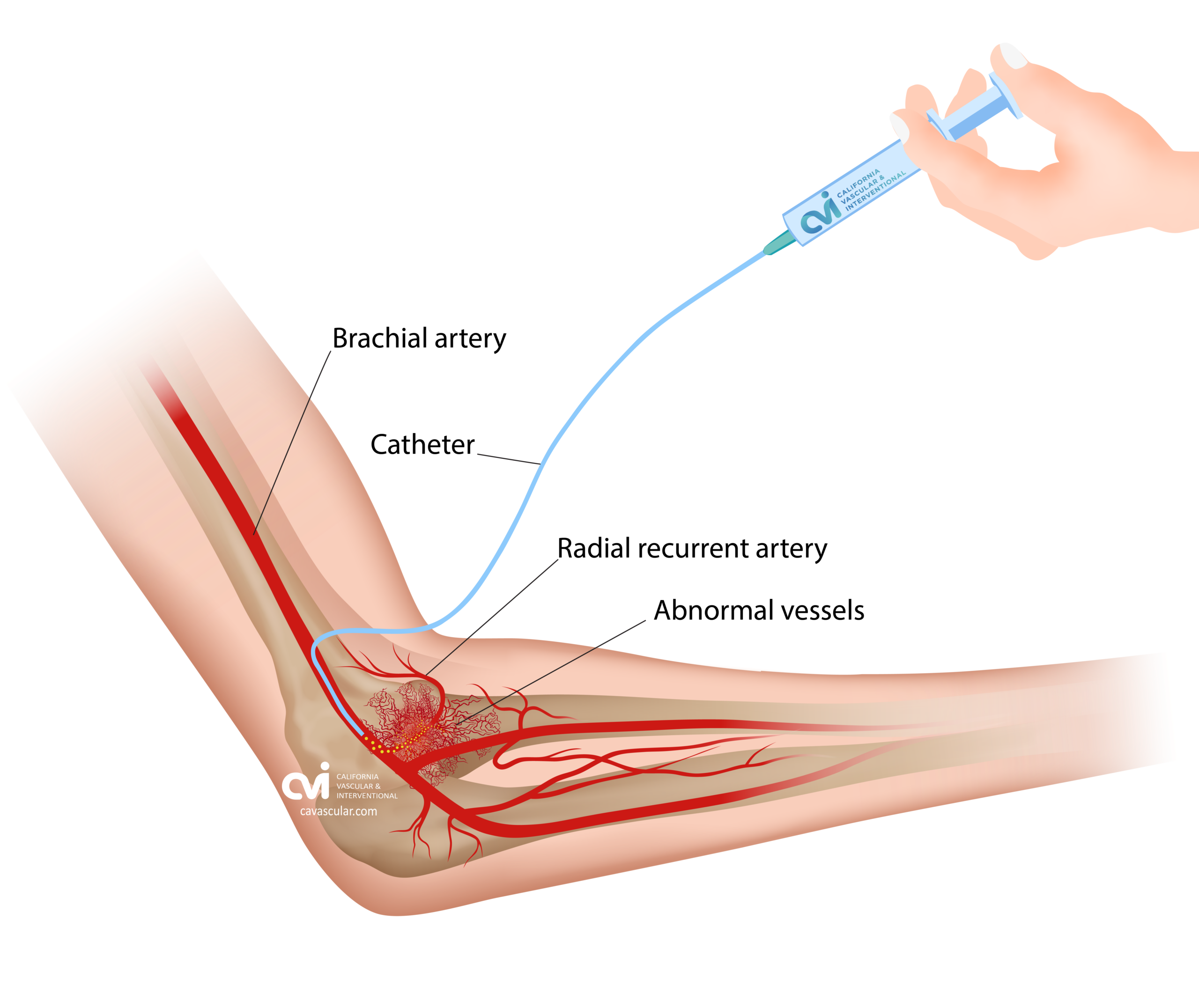
Tennis elbow is caused by microscopic tearing and degeneration of the tendons where they attach to the outside of the elbow. Over time, this triggers the growth of abnormal new blood vessels accompanied by pain-sensing nerve fibers. Rather than helping the tendon heal, these vessels perpetuate pain and actually impair healing.1
This is the key insight behind embolization: if abnormal vessels are driving the pain, reducing their blood supply addresses the pain mechanism directly — without altering the tendon itself.
How tennis elbow is diagnosed
Diagnosis is primarily clinical, supported by imaging when needed:
- Physical exam — pain over the outer elbow and pain with resisted wrist extension.
- History — repetitive use and gripping activities.
- Imaging — ultrasound and MRI can show tendon changes and increased blood flow, helping confirm the diagnosis and rule out other conditions.2
What are the non-surgical treatments for tennis elbow?
First-line management is conservative — but 20–30% of patients develop persistent symptoms lasting longer than 6–12 months.
Standard conservative, non-surgical management includes:
- Activity changes and rest
- Physical therapy and strengthening
- Bracing or counterforce straps
- Anti-inflammatory medications
- Corticosteroid injections — short-term relief only
- Platelet-rich plasma (PRP) injections
While many patients improve with these approaches, 20–30% develop persistent symptoms lasting longer than 6–12 months.3 These patients are often told that surgery is the next option — but it isn’t the only one
What is TAME embolization for tennis elbow?
Transcatheter arterial micro-embolization (TAME) is a minimally invasive, image-guided procedure that treats the pain mechanism directly — without cutting the tendon.
TAME is performed by our board-certified vascular and interventional radiologist. Instead of surgically cutting the tendon, embolization targets the abnormal blood vessels responsible for pain, leaving the tendon intact. This allows symptoms to resolve without physically altering the anatomy of the elbow.
How the TAME procedure is performed
The entire procedure is typically completed in about an hour, in an outpatient setting:
Gentle access
A tiny IV-like catheter is placed in the affected arm using ultrasound guidance.
Pinpoint the vessels
Using live X-ray or ultrasound guidance, our physician identifies the abnormal vessels supplying the painful tendon.
Targeted embolization
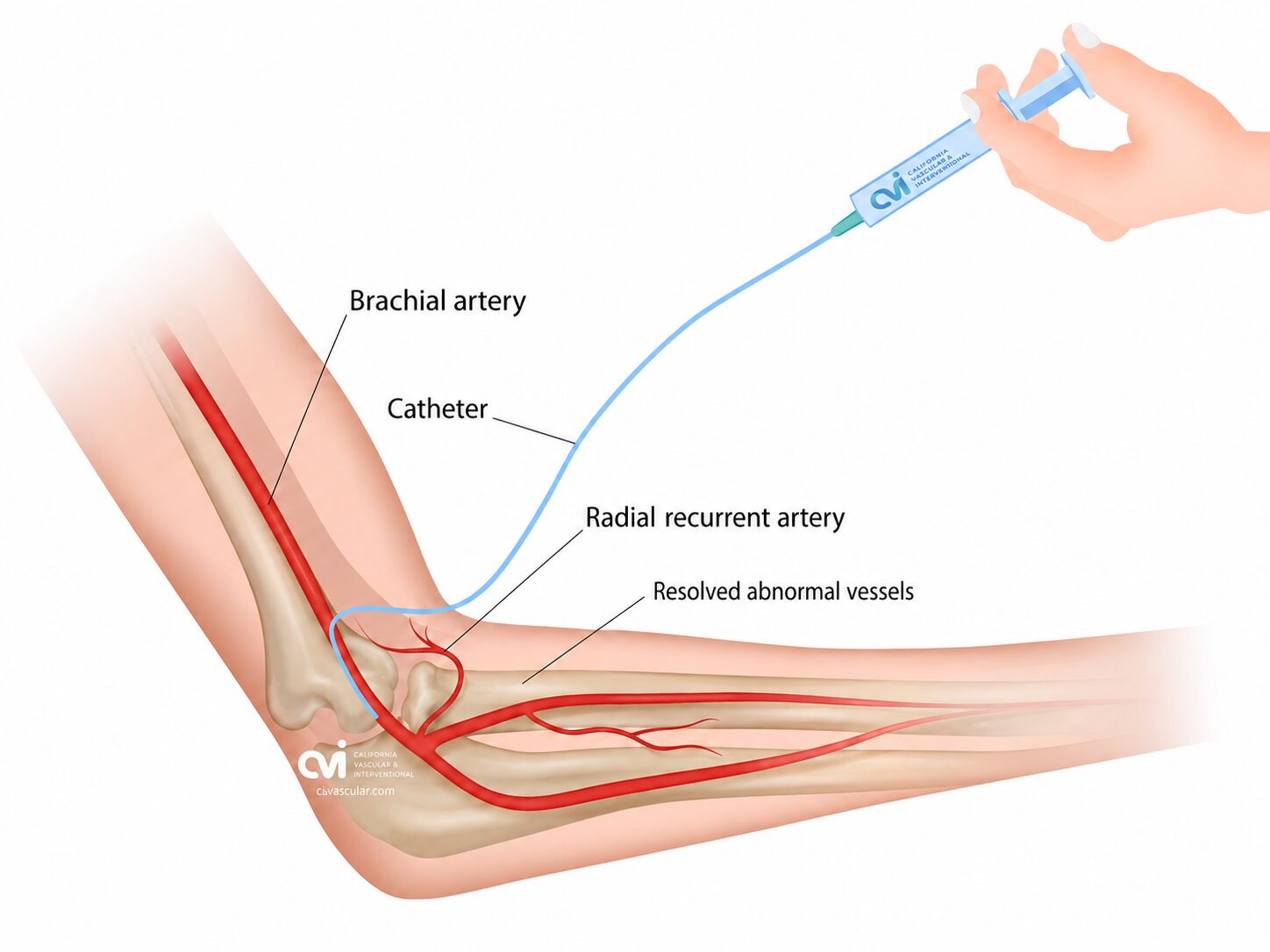
A dissolvable medication is injected to reduce abnormal blood flow and the associated nerve signaling.
Done — just a Band-Aid
The catheter is removed and a Band-Aid is applied. No stitches, no incision.
How effective is embolization for chronic tennis elbow?
Published studies report 70–85% improvement in pain for chronic tennis elbow, often within weeks — including in patients who failed injections and therapy.
Importantly, embolization has shown durable results at 1–2 years in published studies, even in patients who had previously failed injections and physical therapy.6
Risks and safety profile
Embolization is very safe when performed by an experienced interventional radiologist trained and focused in image-guided embolization.
Reported risks are generally minor and short-lived:
- Temporary soreness or bruising at the access site
- Mild post-procedure pain flare — usually short-lived
- Rare transient skin or nerve irritation
Can tennis elbow come back after embolization?
Recurrence rates after TAME are low, with most studies reporting sustained improvement — especially when the underlying activity overload is addressed.
Who is a good candidate for tennis elbow embolization?
TAME is best suited for patients with chronic tennis elbow (longer than 6 months) who have already tried conservative care without lasting relief.
Embolization is best suited for patients who:
- Have chronic tennis elbow (longer than 6 months)
- Have failed physical therapy and injections
- Want to avoid surgery
- Are not ideal surgical candidates
- Prefer minimal downtime and faster recovery
It is not typically used for acute or mild cases that are still improving with conservative care.
How does embolization compare with tennis elbow surgery?
Embolization offers a less invasive option that treats the pain mechanism directly — with comparable pain relief but far less downtime than surgery.
- No incisions or tendon cutting
- Local anesthesia only
- Same-day, outpatient procedure
- Rapid return to activities
- Lower complication risk
- Cuts or debrides tendon tissue
- Requires regional or general anesthesia
- Longer recovery — often months
- Risk of stiffness, weakness, or nerve injury
- Variable success rates (70–90%)
TAME vs. Surgery: a patient-centered comparison
| Feature | Embolization (TAME) | Surgery |
|---|---|---|
| Invasiveness | Minimally invasive | Open or arthroscopic |
| Anesthesia | Local | Regional or general |
| Recovery time | ~1 day | Months |
| Pain relief | 70–85% | 70–90% |
| Repeatable | Yes | Limited |
| Scarring | None | Yes |
While surgery can be effective, embolization offers a less invasive option that treats the pain mechanism directly, without altering tendon structure.7
Request an Appointment
Please note that although we strive to protect and secure our online communications, and use the security measures detailed in our Privacy Policy to protect your information, no data transmitted over the Internet can be guaranteed to be completely secure and no security measures are perfect or impenetrable. If you would like to transmit sensitive information to us, please contact us, without including the sensitive information, to arrange a more secure means of communication. By submitting this form you consent to receive text messages from CVI at the number provided. Msg & data rates may apply. Msg frequency varies. Unsubscribe at any time by replying STOP.
Embolization at California Vascular & Interventional Center
At California Vascular & Interventional Center, embolization for musculoskeletal pain is performed by Dr. Atabak Allaei, a board-certified Vascular and Interventional Radiologist with extensive experience in image-guided embolization procedures.
Dr. Allaei has treated patients with chronic tendon and joint pain using advanced embolization techniques, focusing on precision, safety, and patient comfort. Procedures are performed in an outpatient setting, with careful patient selection and individualized treatment planning. Patients are closely followed to ensure optimal recovery and long-term results.
Atabak Allaei, MD
Double board-certified in Vascular & Interventional Radiology and Diagnostic Radiology by the American Board of Radiology, with sub-specialty fellowship training and a proven track record of more than 5,000 image-guided procedures.
Tennis elbow embolization: common questions
Is tennis elbow an inflammatory condition?
No. Tennis elbow is primarily a degenerative process, not an inflammatory one. It is caused by microscopic tearing and degeneration of the tendons where they attach to the outside of the elbow. Over time this triggers the growth of abnormal new blood vessels and pain-sensing nerve fibers that perpetuate pain and impair healing — which is why anti-inflammatory treatments often provide only limited or short-term relief.
What is TAME embolization for tennis elbow?
Transcatheter arterial micro-embolization (TAME) is a minimally invasive, image-guided procedure that treats chronic tennis elbow by targeting the abnormal blood vessels responsible for pain. Instead of cutting the tendon, a dissolvable embolic agent is injected to reduce abnormal blood flow, leaving the tendon intact.
How effective is embolization for chronic tennis elbow?
Published studies report 70–85% improvement in pain for chronic tennis elbow, often within weeks, with durable results at 1–2 years — even in patients who previously failed injections and physical therapy.
Is tennis elbow embolization safe?
Embolization is very safe when performed by an experienced vascular and interventional radiologist. Reported risks are usually minor: temporary soreness or bruising at the access site, a mild short-lived pain flare, and rare transient skin or nerve irritation. Serious complications such as tissue damage or infection are extremely rare, and no general anesthesia is required.
What is the recovery time after the procedure?
Typical recovery is about one day. Patients are advised to avoid strenuous activity with the treated arm for roughly one week. There are no incisions — only a Band-Aid over the access site.
Who is a good candidate for tennis elbow embolization?
Embolization is best suited for patients with chronic tennis elbow lasting longer than six months who have failed physical therapy and injections, want to avoid surgery, are not ideal surgical candidates, or prefer minimal downtime. It is not typically used for acute or mild cases still improving with conservative care.
How does embolization compare with tennis elbow surgery?
Embolization is minimally invasive with no incisions or tendon cutting, uses local anesthesia, is a same-day procedure with rapid return to activities, and carries a lower complication risk. Surgery involves cutting or debriding tendon tissue, requires regional or general anesthesia, and has a recovery measured in months. Pain relief is comparable — about 70–85% for TAME versus 70–90% for surgery.
Can tennis elbow come back after embolization?
Recurrence rates after TAME are low, and most studies report sustained improvement — especially when the underlying activity overload is addressed. If symptoms do recur, repeat embolization is often possible and far less disruptive than repeat surgery.
Other musculoskeletal conditions we treat
Explore a non-surgical option for chronic elbow pain
Chronic tennis elbow can be frustrating and life-limiting, especially when conservative treatments fail. Embolization is a modern, evidence-based alternative that bridges the gap between injections and surgery — offering meaningful pain relief, faster recovery, and a return to normal activities without an operation.